When it comes to choosing a channel of communication for a company, it can be the difference between a productive team and a dysfunctional one. Slack is a tool used for communication in most workplaces worldwide, but it may not be the perfect fit for everyone. This review considers both the advantages and disadvantages of Slack in a realistic way to help you determine whether it is the right tool for your team.
You will understand the benefits of Slack, such as real-time collaboration, a wealth of integrations, and flexibility, as well as the factors that can lead to problems, such as distractions, security issues, and cost.
Slack Pros and Cons
| Feature Analysis | Category | |
|---|---|---|
| Real-time messaging and fast feedback | PRO | |
| Thousands of app integrations | PRO | |
| Intuitive and customizable interface | PRO | |
| Strong remote collaboration tools | PRO | |
| Powerful search and organization | PRO | |
| Constant notifications can reduce focus | CON | |
| No default end-to-end encryption | CON | |
| Information overload for new users | CON | |
| Free plan has major limitations | CON | |
| Costs add up for growing teams | CON | |
Slack's Pros
.webp)
Slack is widely recognized for its neat layout and feature-rich options that are still quite user-friendly. Teams of all sizes, from small startups to large-scale international organizations, are leveraging Slack as their primary communication platform and consequently reducing the use of internal emails.
In case your team is looking for a place where all your daily chats, quick decisions, and collaborative work can be neatly organized, you can't go wrong with Slack.
Real-Time Messaging and Instant Feedback
Through Slack, your team feels as if they are physically collaborating even when distributed across geographies. Since communication happens in real time, the feedback cycle is significantly shortened, and the entire decision-making process is sped up.
Some of the most essential communication features are:
- Direct messages for 1:1 chat
- Private channels for in-depth discussions
- Convenient file sharing within discussions
- Emoji reactions for a quick silent nod without filling the chat with unnecessary messages
Such promptness makes sense in the context of a high-speed project where it is simply impossible to wait for hours for an email response.
Besides, Slack offers voice and video call options, which come in handy when people want to add a layer of facial expressions and gestures, thus when the conversation needs more nuance than text alone.
File Sharing and Tool Integration
Slack is not just a messaging app; it also connects your team's existing tools. Slack becomes the central nervous system of work through its over 2,600 integrations.
Files, documents, and updates are sent straight to the channels, so people don’t have to switch between apps so much. It doesn’t matter if you share Google Drive documents or get automatic alerts from your favorite tools, such as form builders and project managers; the interface, combined with Slack, helps you to keep everything in one place.
Such a centralized pattern enhances visibility, informs everyone, and thus it keeps the collaboration process smooth and efficient.
Remote Collaboration Made Simple
Thanks to Slack, video calls and screen sharing are used effectively for meetings and brainstorming sessions to bring even organisation members who are physically apart closer together.
Because teams can be located anywhere, it is increasingly common for work to be carried out in a distributed manner; thus, Slack offers various solutions for remote workers.
- Start a video call spontaneously.
- Work together at the same time on the screens sharing
- Fix a problem fast without lots of emails
These options enable remote workers to experience that they belong to the team and everyone cares about them even though they are in different locations.
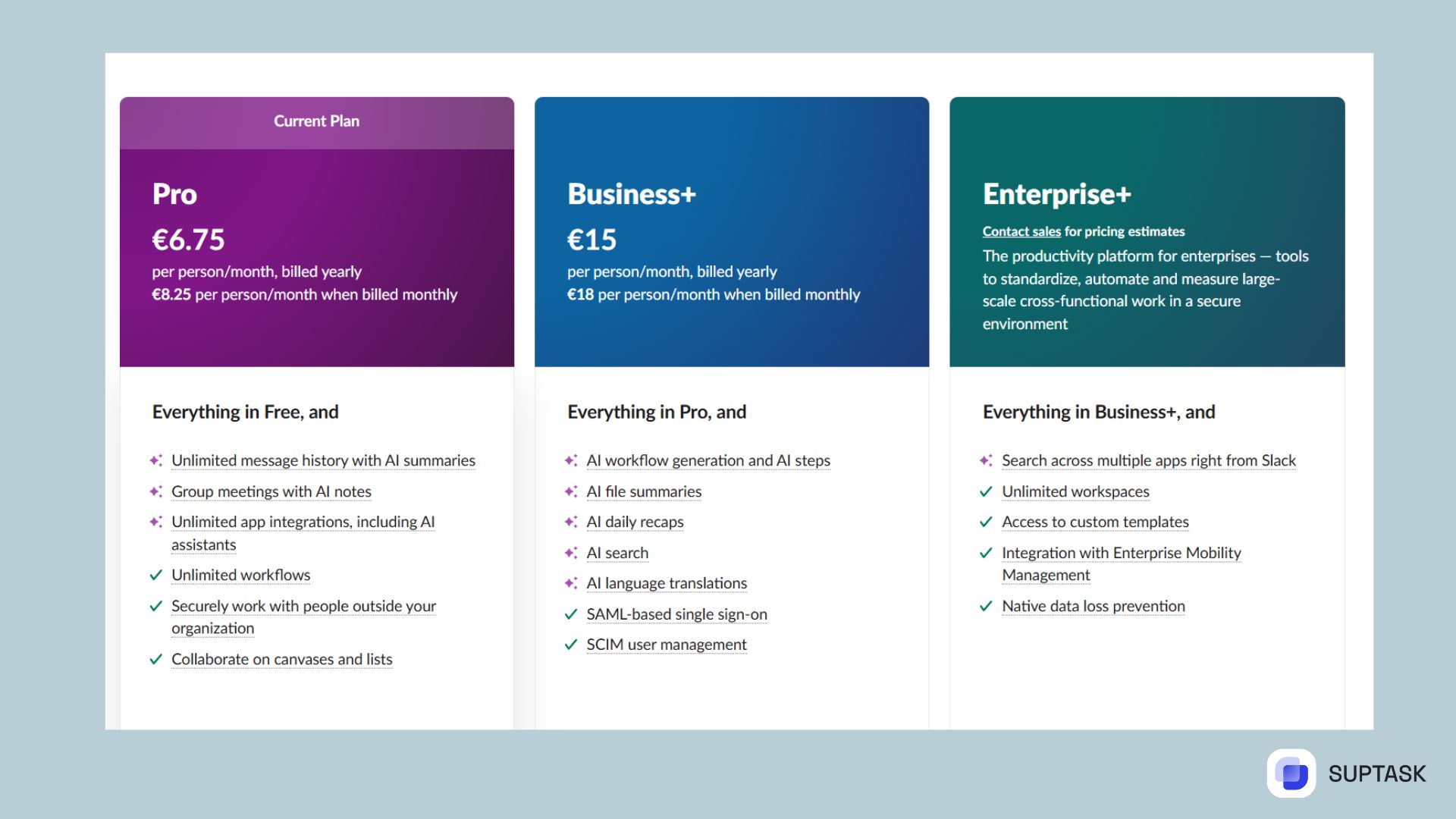
Flexible Pricing Plans
Slack’s pricing is designed to scale with your business:
Turn Slack Conversations into Resolutions
Suptask organizes your team's workflow, capturing issues from chats and eliminating lengthy email exchanges.
 Get Started for Free
Integrations and Workflow Automation
An integral part of Slack’s strength is its integrations. For instance, project progress from a project management tool such as Suptask can be displayed directly in the channels, while CRM changes are automatically imported.
It is also possible for teams to transform their internal workflows by consolidating support request management and issue handling with Slack-based ticketing systems like Suptask, so they do not have to leave Slack.
Having developed an ecosystem for over 10 years, Slack is compatible with a wide range of tools spanning HR, operations, development, and customer support, making it an efficiency booster for all sorts of teams.
User-Friendly Interface
Slack offers a very familiar and flexible interface. The sidebar neatly organizes channels, direct messages, and reminders, making it easy for users to keep track of everything, even in large workspaces.
Messages in a chat are neat, and you can easily add formatting or search them. Various features, such as mentions, file sharing, and message formatting, ensure effective team communication with hardly any tension.
Powerful Search Functionality
With Slack's powerful search feature, teams can stay well-organized even as conversations and files accumulate. A combination of filters, keywords, and date ranges can be used to locate messages, documents, and links quickly.
Slack’s Cons

Even though Slack has many advantages, it still has its faults. It is essential to understand these platform limitations before you decide to use it.
Constant Notifications and Reduced Focus
Slack definitely plays a significant role in informing teams of what’s going on, but it can be over-informing at times. If people get a lot of messages all the time, it’s very likely their work will be interrupted, and their mood will shift to a reactive state.
Therefore, they wouldn’t be able to concentrate on their challenging assignments because they would be switching between conversations all the time.
To lessen this, Slack gives the possibility of:
- ignoring a channel
- disabling notifications
- only letting through, different types of notifications
If one uses these options wisely, it should be possible to find a good balance between communication and deep work.
Security Considerations
Security is among the main issues raised in any communication channel. Events like password leaks and phishing attacks reveal the dangers of digital collaboration tools.
Slack has introduced several security protocols in response to these, such as Enterprise Key Management and Native Data Loss Prevention. However, if a user relies on the absence of complete end to end encryption, then he/she would have to realise that his/her data is exposed unless he/she actively manage data retention policies.
When dealing with security-related issues, it is better to use more formal, secure tools that provide ticketing and archiving, such as email or a Slack ticketing system.
Learning Curve and Information Overload
New users may feel overwhelmed by Slack’s channels, notifications, and features. Without clear guidelines, workspaces can quickly become noisy and difficult to navigate.
With proper onboarding, training, and channel organization, however, teams can turn Slack into a productivity enabler rather than a distraction.
Learning Curve and Information Overload
Slack, with its channels, notifications, and some other features, may be too much for a beginner. Since there is no regulation, the work environment can become very loud and hard to navigate.
Through proper orientation, training, and channel arrangement, team members actually see Slack as a helpful tool rather than a source of distraction.
Pricing Compared to Competitors
Slack offers excellent pricing flexibility. Still, it should be noted that its free plan has a very short message history limit of 90 days, which may pose a problem for teams that are heavily dependent on long-term recordkeeping.
On the other hand, Basecamp offers users greater file upload capacity at a higher cost, or with different pricing models. It is therefore indispensable to compare tools based on your group’s work process, budget, and collaboration requirements.
If your group has already adopted Slack, you may consider Suptask’s free ticketing system as a third-party tool that can provide structure without adding to your program expenditure.
Slack FAQ
What are the disadvantages of Slack?
What is Slack best used for?
Why is Slack so useful?
What are the advantages of using Slack?
Can Slack integrate with project management tools?