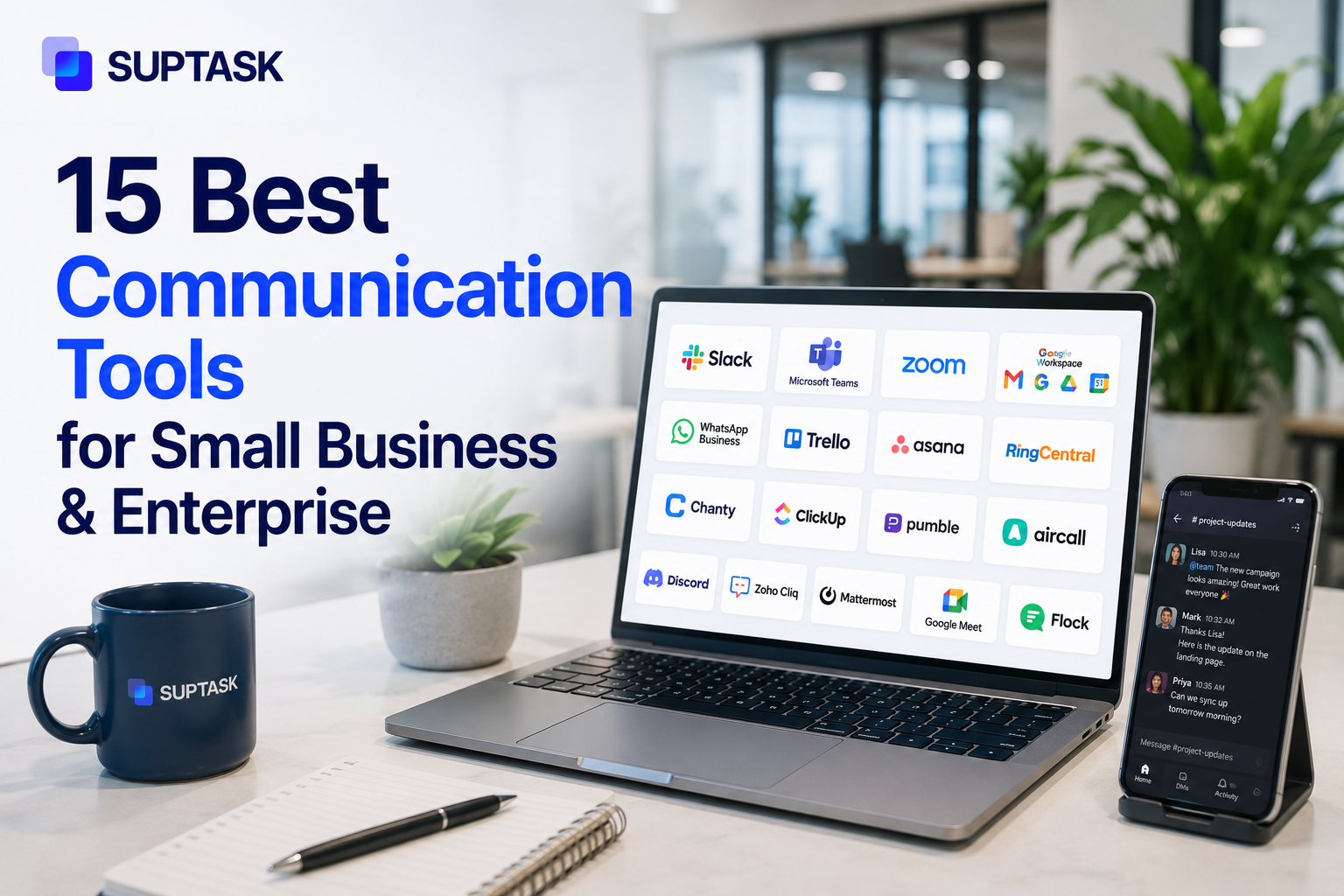
The best communication tool depends on what your team actually needs, but most of the work falls into four functions: instant messaging, video conferencing, all-in-one suites, and project management.
This post covers the leading tool in each function, with current pricing and a short note on who it fits. Most teams do not run a single tool; they run three or four together, one for chat, one for calls, one for email and documents, and one to track the work. So there is no single winner here. The list is organised by function so you can match the category to whatever you are missing.
How to Choose a Business Communication Tool?
How you choose comes down to a few things. Mostly it is the size of your team and what the team already pays for. Real-time or async is the first split to think about. Chat and calls keep everyone in sync,they also interrupt a lot, and the async tools hand people back their focus time while the less urgent stuff waits. Then there is the suite question. A bundled option like Google Workspace or Microsoft 365 gives you one bill and one login to manage.
A tool built for a single job can usually do that job better than the one baked into a suite. Price you weigh against how deep the features run. The cheap tier looks fine until a team grows and needs the admin controls it does not have. Security against ease of use is the last one. The tools with the strictest controls are the hardest to actually roll out.
Team size decides a lot of this. Five people get by on free tiers and one or two apps. Past a few hundred people, it changes, the integration and the provisioning and the audit trail start to matter more than the length of the feature list.
This one is written for teams of 5 up to 1000 or more, the ones putting a stack together from scratch or replacing one tool in the stack they have. Budget-first setups for a handful of people lean on free tiers and the cheaper all-in-ones, and that is the ground the best small business collaboration tools guide covers in full, so this list keeps to the wider business and enterprise choices. Engineering teams run a different stack built around the code repository and the review workflow, which is what the developer collaboration tools roundup goes deep on, so those are left out here.
The 4 Types of Business Communication Tools
There are four types most business tools fall into. The first is synchronous chat, the instant messaging kind, where Slack and Teams sit. You need it when the work moves fast, and people expect a reply in minutes, not the next day.
Then there is video. Same synchronous idea, only it is face-to-face, the calls, the webinars, and the screen shares. This is the one you reach for when a message thread is going nowhere, and it should just be a meeting.
All-in-one suites work differently. Google Workspace and Microsoft 365 roll the email, the docs, the storage, and often the chat into one login. It makes sense when you would rather pay one bill and manage one identity stack than wire up five separate tools.
The last one is async, the document-based kind. A Loom video, a Notion page, a comment left on a doc- none of it needs everyone online at the same time. You want this when the team is spread across time zones, or when a thing is better written down once than explained in five separate meetings.
Best Instant Messaging and Team Chat Tools
Chat is the category most teams use all day, so it is worth getting right first.
Slack
Slack is the industry standard for fast, channel-based team chat, and most of the other tools here get measured back against it.
- Channels for each team, project, or topic, so the day is not one long inbox thread.
- Huddles, the quick audio or video call you start inside a channel without booking a thing.
- Search over the full history, though the free plan only keeps the last 90 days of it.
- Thousands of integrations, plus workflow automation for repetitive jobs.
The app directory is the deepest of any tool on this list, and the best Slack apps roundup goes through the ones worth adding. On price and admin depth, it lands differently from Google's option, which the Google Chat vs Slack comparison walks through.
- Best for: Teams that want the widest integration ecosystem and will pay per seat for it.
- Pricing: Pro is $8.75 per user per month, or $7.25 on annual billing, and Business+ is $15, or $12.50 annually, with a free plan underneath (Slack pricing, as of July 2026).
- Pros: The integrations are unmatched, and new people pick it up in a day.
- Cons: The per-seat cost climbs quickly, and the 90-day free limit hurts once you lean on search.
Microsoft Teams
Teams comes bundled into Microsoft 365, so for a lot of companies it is already paid for and already switched on.
- Chat and channels sitting next to Word, Excel and SharePoint in one place.
- Video meetings up to 300 people, built into the same app.
- Tight ties into Outlook and the rest of the Office stack.
- Best for: Organisations already on Microsoft 365, where a second chat tool is hard to justify.
- Pricing: Teams Essentials is $4 per user per month on annual billing, and the fuller version comes with the M365 Business plans (Teams plans, as of July 2026).
- Pros: You can use it at no cost if you have been using Microsoft Office already.
- Cons: The interface might take more time to get familiar with compared to Slack.
Google Chat
On the Google side of the fence, Chat is the messaging piece that ships inside Workspace next to Gmail, Docs, and Meet.
- Spaces for group conversation, threaded so topics do not collide.
- It connects straight into Drive and Docs for sharing.
- Free with any personal Google account, not only the paid plans.
- Best for: If you have been on the Google Workspace, then Chat can help you add communication capabilities.
- Pricing: It can be purchased along with Google Workspace from pricing starting from $7 per user per month annually, or $8.40 monthly, on Business Starter (Workspace pricing, as of July 2026).
- Pros: No extra cost for Workspace teams and intuitive to use.
- Cons: The integration ecosystem is thin next to Slack, and it is rarely a reason to pick Google on its own.
Discord
Discord is one of the best communication tools meant for communities and gaming. It is among the most default picks for B2B teams.
- Voice channels people drop in and out of throughout the day.
- Servers split into channels, similar to Slack.
- A free tier that covers a surprising amount.
- Best for: Community-led businesses, creator teams, and some developer groups.
- Pricing: Free to use, with Nitro at $9.99 per month for extras, though that is a personal add-on and not per-seat (Discord Nitro, as of July 2026).
- Pros: You can use it for free a long way, and the voice-channel model is genuinely good.
- Cons: No real business admin layer, and it looks informal to clients.
Best Video Conferencing Tools
Video is the next piece. It comes down to reliability more than features, and four tools cover most of it.
Zoom
Zoom is the one most people reach for, and it stays reliable for the meetings, the webinars, and the screen sharing.
- Runs the face-to-face meetings reliably, even on a patchy connection.
- Webinars and the bigger events sit behind a paid add-on.
- On recording, the calls save to the cloud so you can go back over them.
- A free version is there too, supporting group calls up to 40 minutes.
- Best for: Teams that want video to just work without much setup.
- Pricing: Pro is $13.33 per user a month on annual billing, or $16.99 monthly (Zoom pricing, as of July 2026).
- Pros: Reliable when the connection is weak, and almost everyone has used it before.
- Cons: The cost builds up with webinars and larger rooms, and the 40-minute free cap is tight.
Google Meet
Google Meet comes free inside Workspace, so Google teams tend to use it without shopping around.
- Opens in the browser, nothing to install.
- The invite links come straight off the calendar.
- Recordings saved into Drive with the rest of your files.
- For the big webinar-style events, there is not much here.
- Best for: Google Workspace teams who want calls without adding another tool.
- Pricing: Bundled with Workspace from $7 per user a month on Business Starter (Workspace pricing, as of July 2026).
- Pros: No separate bill for Workspace teams, and it stays simple to use.
- Cons: Lighter on features than Zoom, and weak for large events.
Microsoft Teams Meetings
Teams Meetings is the same Microsoft Teams from the chat section, only this is the video side of it.
- Comes in the Microsoft 365 bundle, so it is already paid for.
- Meetings hold up to 300 people.
- Scheduling runs through Outlook, one click from an email.
- Best for: M365-native teams who do not want a second video tool.
- Pricing: Follows the M365 plans, with Teams Essentials from $4 per user a month yearly (Teams plans, as of July 2026).
- Pros: No extra cost on Microsoft 365, and strong admin controls.
- Cons: Heavier than Zoom, and external guests sometimes struggle with joining.
Webex
Webex leans enterprise, and it shows up most in regulated industries like banking, healthcare, and government.
- It carries strong encryption and admin controls, which is the enterprise draw.
- The compliance certifications matter to the regulated buyers.
- There is a free tier as well, capped at 40 minutes like the others.
- Best for: Large or regulated organisations that need an enterprise secure communication tool.
- Pricing: Webex Meet is $14.50 per user a month, with a fuller Suite above it and a free tier below (Webex pricing, as of July 2026).
- Pros: Built for security and compliance, and it scales to big organisations.
- Cons: More than a small team needs, and the price reflects the enterprise focus.
Best All-In-One Productivity Suites
An all-in-one suite bundles the email, the docs, the storage, and the chat under one login. For a lot of companies, it ends up being the main internal communication tool too, since the messaging comes baked in. Two names cover most of this space.
Google Workspace
Google Workspace rolls the set into one, Gmail, Docs, Meet, Drive, and Chat, so the communication and the files sit in the same place.
- Gmail, Docs, Sheets, and Slides, all in the browser.
- Chat and Meet come built in, so the messaging and the calls are included.
- Drive holds the files, and people work off the same version.
- Admin runs from one console, for the accounts and the permissions.
- Best for: Teams that want one bill and one identity stack instead of wiring separate tools together.
- Pricing: Business Starter is $7 per user a month on annual billing, or $8.40 monthly, with Standard and Plus above it (Workspace pricing, as of July 2026).
- Pros: The parts all connect, and it stays simple to run.
- Cons: The document tools are lighter than Office for heavy spreadsheet work, and offline use is weaker.
Microsoft 365
Microsoft 365 is the other big suite, built around Teams, Outlook, Word, Excel and SharePoint.
- The desktop Office apps are here, still the standard for the heavy documents and spreadsheets.
- Teams come bundled for the chat and the meetings.
- Email and calendar run through Outlook.
- SharePoint and OneDrive hold the files and the intranet side.
- Best for: Enterprises and any org with Office-heavy workflows already in place.
- Pricing: Business Basic is $7 per user a month on annual billing, Business Standard $14, and Premium $22 (Microsoft 365 pricing, as of July 2026).
- Pros: The Office apps are unmatched for deep documents, and the enterprise controls run deep.
- Cons: It can feel heavy, and the licensing tiers get confusing fast.
Best Project Management Tools With Communication Features
These are project management tools, but the reason they sit in this list is the communication baked into the work itself.
Asana
Asana handles the tracking side, the tasks, the projects, and who owns what.
- Keeps the conversation attached to each task, so comments and files stay with the work.
- Timelines, boards, and lists for how a project moves along.
- It automates the repetitive steps for you.
- There is a free plan for small groups.
- Best for: Teams that want structured project tracking with the discussion kept in one place.
- Pricing: Starter is $10.99 per user per month annually, with Advanced above it (Asana pricing, as of July 2026).
- Pros: Strong for structured work, and the comments keep context on the task.
- Cons: It gets complex fast, and the price climbs on the higher tiers.
Trello
Trello is the card-and-board style, where each task is a card you drag across columns.
- Easy to pick up, barely any learning curve.
- Comments go on the back of each card for back-and-forth.
- Power-Ups bolt on extra features when you need them.
- Best for: Small teams that want something light and visual.
- Pricing: The free plan covers a lot, and Standard is $5 per user per month annually. Premium is $10 (Trello pricing, as of July 2026).
- Pros: Easy and cheap to start, and the board view is clear.
- Cons: It gets thin for the bigger, complex projects, and reporting is basic.
monday.com
monday.com is the most visual of the three, and it leans on the colour-coded boards.
- Colour-coded boards that show where everything stands at a glance.
- It gets used for past projects too, for the CRM and the campaigns.
- Automation and dashboards come on the paid plans.
- Best for: Teams that want one visual tool stretching past task tracking.
- Pricing: There is a limited free tier, and Basic starts around $9 a seat annually, Standard $12, with a three-seat minimum (monday.com pricing, as of July 2026).
- Pros: Very visual, and it flexes to different kinds of work.
- Cons: The three-seat minimum stings small teams, and costs rise with add-ons.
Only three here, and on purpose, since these are the ones that double as communication tools. Smaller teams weighing the fuller project-management lineup will get more from the best small business collaboration tools guide. For the wider collaboration set beyond project management, the top online collaborative tools roundup goes into it.
Best Internal Communications Platforms
Internal communications platforms are a different thing from team chat. Instead of the real-time back and forth, they handle the broadcast side, the company newsletter, the org-wide announcements, the messages that go out to everyone at once. Bigger companies run one of these next to their chat tool, not instead of it.
Staffbase
Staffbase runs on a company app and intranet, built for employee communications across a whole organisation.
- An employee app and intranet for the org-wide updates.
- Targeted messages, so a post reaches the right department or location.
- Analytics on who opened and read what.
- Works for the frontline staff who do not sit at a desk.
- Best for: Large and enterprise companies with a big deskless or distributed workforce.
- Pricing: Quote-based, you talk to their sales team for a number (as of July 2026).
- Pros: Strong for reaching everyone, and good for the non-desk staff.
- Cons: It is enterprise-scale, so overkill and pricey for a small team.
ContactMonkey
ContactMonkey comes at internal comms from the email side, it plugs into Outlook and Gmail for the employee newsletter.
- Builds and sends the internal newsletters from inside your email.
- Tracks opens, clicks, and read rates on those sends.
- Templates and a drag-and-drop builder for the layout.
- Best for: Internal comms and HR teams that live in email and want the metrics.
- Pricing: Quote-based, priced on request (as of July 2026).
- Pros: No new inbox to learn since it runs inside your email, and the analytics are detailed.
- Cons: It is focused on email newsletters, not the wider messaging.
Workvivo
Workvivo is more of a social intranet, it feels like an internal social feed for the company.
- A social-style feed for the company news and the shout-outs.
- Spaces for teams, plus the org-wide broadcast.
- Owned by Zoom now, so it ties into that side.
- Best for: Companies that want employee engagement and culture, not only announcements.
- Pricing: Custom pricing, contact sales (as of July 2026).
- Pros: Good for engagement and the culture side, and people find it familiar.
- Cons: Less about day-to-day work, more about the company feed.
Best Async and Specialised Communication Tools
For the distributed and remote teams, some of the most useful tools are not chat or video at all. They are the async ones, the tools that let people communicate without being online at the same time. A lot of remote work actually happens here.
Loom (async video)
Loom is an async video, you record your screen and your face and send the link, no meeting needed.
- Screen and camera recording for the walkthroughs and the explanations.
- A shareable link, people watch when it suits them.
- Comments and reactions on the video itself.
- Transcripts and AI summaries on the higher plan.
- Best for: Remote teams that want to explain something without booking a call.
- Pricing: Free tier, and Business is $15 per user a month annually, or $18 monthly (Loom pricing, as of July 2026).
- Pros: Cuts out a lot of unnecessary meetings, and it is easy to record.
- Cons: It is one-way, not for the back and forth.
Notion / Confluence (async knowledge)
With Notion and Confluence, you get documents and wikis, which are communication too, the written kind that stays put.
- Docs, wikis, and knowledge bases the whole team can read.
- The information stays in one place instead of buried in chat.
- They overlap with the all-in-one suites, so you may already run something similar.
- Best for: Teams that want a written source of truth people can go back to.
- Pricing: Notion Plus is $10 per user per month annual, Business is $20 (Notion pricing, as of July 2026). Confluence Standard is about $5.42 per user a month, with a free tier for up to 10 people (Confluence pricing, as of July 2026).
- Pros: Strong for the written record, and easy to organise.
- Cons: It overlaps with tools you may already have, and someone has to keep it tidy.
Front (shared inbox for client communication)
Front is a shared inbox where a team handles the client-facing email together.
- One shared inbox for the email, the SMS, and the chat channels.
- The team assigns, comments, and replies on messages together.
- Built for client and B2B communication, not internal chat.
- Best for: Support, success, and B2B teams handling shared client conversations.
- Pricing: Starter is $25 a seat a month annually, Professional $65 (Front pricing, as of July 2026).
- Pros: Keeps client email from falling through the cracks, and the collaboration is built in.
- Cons: It is pricey per seat, and it is for external comms, not the internal team chat.
Twist (async-first chat)
Twist takes chat and makes it async-first, the conversations happen in threads, and nobody feels they have to reply the second a message lands.
- Threaded conversations instead of a fast-moving feed.
- Made for distributed teams across time zones.
- A free tier, with a paid plan for more.
- Best for: Remote-first teams that want the calmer version of chat.
- Pricing: Free tier, and the paid plan is $5 per user a month (Twist pricing, as of July 2026).
- Pros: Calmer than Slack, and good across time zones.
- Cons: A small ecosystem, and the async style does not suit every team.
How to Build Your Communication Stack (Don't Pick One Tool, Pick a Combination)
This is the part most of the lists leave out. No single tool does all of it, so what teams end up doing is running a few together. Three or four is normal, and each one is there to cover a function, something like:
- One for the chat, that is Slack or Teams.
- Video, which is usually Zoom.
- An all-in-one for the email and the docs, so Google Workspace or Microsoft 365.
- The project tracking, Asana or Trello.
- Sometimes a fifth one too, Loom for the async video, or Front when there is client email to deal with.
How that looks depends on the size. Three examples:
- A small team or a startup keeps it cheap. Slack, Zoom, Google Workspace, and Trello cover the four functions, and paid at the entry tiers it works out around $30 to $35 a user a month. On the free plans, it is much less.
- Mid-market wants more depth. The chat, the video, and the Workspace stay, Trello gets swapped for Asana on the heavier projects, and Loom comes in for the async video. That is closer to $50 a user.
- Enterprise is a different setup again. Microsoft 365 for Teams, Outlook and SharePoint, Webex for the regulated calls, Asana or monday.com for the projects, and Staffbase for the org-wide comms. Pricing is quote-based here, sales gives you the number.
A word of warning though. More tools do not mean better. Past a certain point, they pull everyone's attention in different directions, and people lose track of where a conversation even happened. Treat four functions as the most you need. You do not have to hit all four.
There is one more layer that can fit here, but only when two things are true. Your team already works in Slack, and it also deals with the internal requests, the IT ones, the HR ones, the ops ones. Suptask runs inside Slack and turns those requests into tickets the team can track, right in the channel where they came in, so nobody opens a separate portal or needs another login. That Slack integration is really the whole point of it.
Enterprise Considerations (Security, Compliance, Scale)
For an enterprise, the shortlist gets shorter fast. The enterprise communication tools that make it have to clear the same bar, and by this point the decision runs on security and scale more than features.
- Compliance is the first gate. SOC 2, ISO 27001, HIPAA-readiness, GDPR, and the enterprise-grade tools like Slack Enterprise Grid, Microsoft Teams, Zoom, and Webex tend to cover the lot.
- SSO and SCIM provisioning, so people get access through the company identity system and lose it when they leave. Table stakes at this size.
- Data residency matters if you are in the EU or APAC, where the data has to stay inside a certain region.
- Then the admin side, the audit logs, the retention policies, the controls over who can do what.
- On encryption, Webex and Zoom both do end-to-end. Slack Enterprise Grid has the stricter key and control options.
None of this matters for a team of ten. For a large or regulated organisation, it is most of the decision, and it is why the enterprise secure communication tool usually comes down to the same few names.
Common Mistakes When Choosing Communication Tools
A few mistakes come up again and again when teams pick these tools. Worth knowing them before you sign anything.
- Trying to make one tool do everything. None of them does, so plan for the stack of three or four from the start.
- The enterprise tier is another one. Teams buy it when the standard plan would have done, and the SSO and the compliance certs are only worth the money if you genuinely need them.
- Switching costs get underrated. Moving from Slack to Teams, or back the other way, is months of work and not a weekend job.
- Then there is the overlap with what you already run. Microsoft 365 companies usually default to Teams, and Google Workspace ones to Google Chat, so picking against the suite tends to cost you more later.
- A slick demo fools people. Most of them look identical in the first ten minutes, it is the day-two experience that actually tells you something.
None of these are complicated to avoid. They just need you to be honest about what the team really needs before the sales call, not during it.
Frequently Asked Questions
What is the most effective communication tool?
There is not really one. It depends on what you are trying to do, Slack for the chat, Zoom for the video, Google Workspace or Microsoft 365 when you want it all in one place. So the honest answer is the most effective setup is a few tools together, not a single winner.
What are the tools used in business communication?
Business communication tools split into four broad jobs, the messaging, video, all-in-one suites, and the project side. A business will normally run one from each rather than a single app that claims to do the lot.
What are the 5 C's of business communication?
These are communication principles, not a tool, clarity, conciseness, completeness, consideration, and correctness. They are about how you write and speak so a message actually lands. The tools on this page help you send it, the 5 C's are about what you put in it.
What's the difference between team chat tools and internal communications platforms?
Team chat is the real-time back and forth, Slack and Teams, where people talk through the day. Internal comms platforms like Staffbase, Workvivo and ContactMonkey are more one-to-many, the newsletters, the announcements, the company-wide messages. A lot of bigger companies run both, one for the talking and one for the broadcasting.
Is Slack still the best team communication tool in 2026?
For most teams that are not already on Microsoft 365, yes, it is still the one to beat on the chat side. If a company already runs M365 though, Teams usually wins by default, because it is there and it is paid for. So it comes down to what you already use more than which one is better on paper.
What's a good Slack alternative for small teams?
Google Chat is the obvious one if you already pay for Workspace, since it comes free with it. Discord works for some community-led or creator teams, though it is informal for most B2B. For a proper small-business comparison, the best small business collaboration tools guide runs through the cheaper options in more detail.
What's the difference between communication tools and collaboration tools?
Communication tools are for the conversation, the chat, the calls, the email. Collaboration tools are for the shared work itself, the docs, the project boards, the design files. The line blurs because most modern tools do a bit of both, and the what collaboration tools actually are explainer covers where the two split.
Does Suptask compete with Slack or Microsoft Teams?
No. Suptask is a ticketing platform that runs inside Slack, not a chat or communication tool. It works alongside Slack, turning requests into tickets, instead of replacing it.