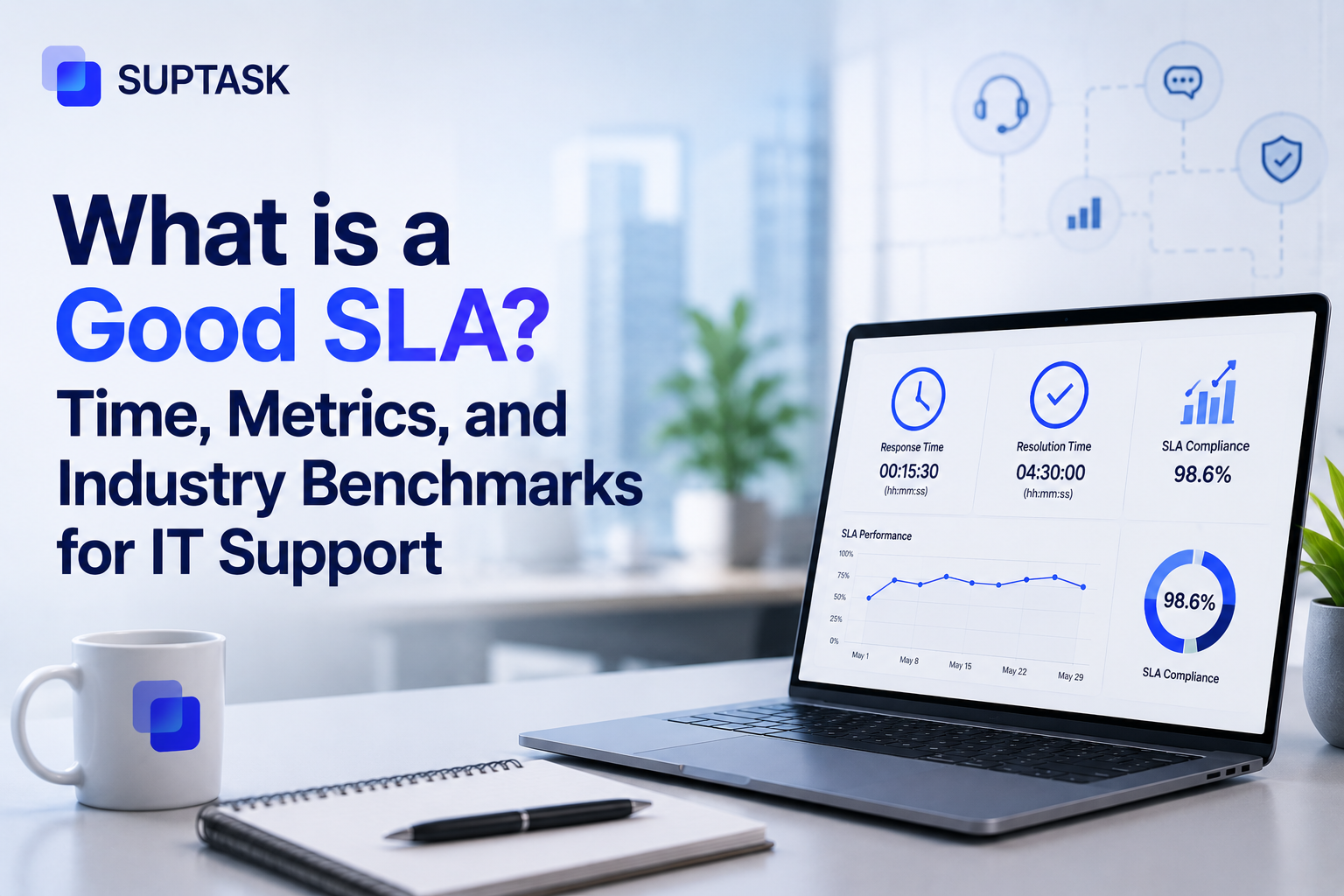
What is a good SLA? This is one of the most commonly asked questions in IT contracts, and it has no one-line definitive answer. A good SLA is made of two things working together. First is time, how fast you promised to respond and resolve. The second is metrics that tell you how well you actually managed to fulfill those promises.
This blog helps you understand both of them. From SLA benchmarks for response time and resolution time by priority, to the core SLA metrics that show whether you are compliant, and how those metrics change across incident management, problem management, and call centres.
So, let’s get started.
What is SLA response time?
SLA response time is referred to as the maximum time a service provides to promise to acknowledge a customer's request. Simply put, it is the time between when a ticket is logged and a message is sent to the requester saying we have received your request. However, people often misunderstand it as the time to resolve a ticket, which is another thing.
Response time only covers the first reply, and usually, automated messages like thanks, we got your request are counted in the SLA, unless the SLA explicitly says so. It only counts the real response from someone who is working on the request.
Response time vs resolution time
Response time and resolution time are the two things that are often mixed up, but have different meanings. Response time is when an agent acknowledges the ticket, and it is fast. Resolution time is when the issue is actually fixed, and it is slower, sometimes much slower.
Providers like to commit to a short response time, because it is easy to hit, while leaving resolution time vague or unmentioned. So, it looks good on paper, but the response time only ensures that the agent acknowledges the ticket, but nothing has been resolved yet.
So if you are evaluating an SLA, you should emphasise the resolution time, rather than response time.
Standard SLA benchmarks by priority (P1 to P4)
Most IT SLAs sort tickets into priority levels, P1 through P4, and set different response and resolution targets for each. Here is what those targets typically look like.
The benchmark reference table
These are the typical industry benchmarks, not recognized as the universal standard. You should define the benchmarks that are aligned with your team, tools, and what your customers need.
Business hours vs 24/7 coverage
There are two types of coverage, one that covers the response during working hours and the other that ensures 24/7 coverage. The cost will vary according to the coverage you have chosen. Therefore, you should assess your needs and choose the coverage accordingly.
24/7 coverage is often mandatory in regulated industries that have production-critical systems or where customers span across multiple time zones. So, if you have customers whose needs to be addressed immediately, even beyond working hours, then 24/7 coverage must be provided.
B2B vs B2C SLA conventions
SLA conventions also vary from B2B to B2C. B2C SLAs often emphasize fast response time because the volume is high. However, in B2B, customer support is often driven by the target, such as P1 issues must be addressed immediately, while P4 might wait.
Core SLA metrics and how to measure compliance
Times are what you commit to. SLA metrics are how you prove whether you are hitting them. Here we have compiled a list of a few of the core SLA metrics and how you can measure them:
The core metrics every SLA tracks
These are the measurements that appear in a typical SLA contract:
- Response time: How fast does the first acknowledgment come?
- Resolution time: How long until the issue is fully fixed?
- SLA compliance rate: The percentage of tickets that met their target.
- Breach rate: The percentage of tickets that failed to meet SLA.
- Time to acknowledge (TTA): Automated acknowledgement of the ticket.
- Mean time to resolution (MTTR): The average resolution time across all tickets.
- Mean time to acknowledge (MTTA): The average acknowledgment time.
- First contact resolution within SLA: The percentage of tickets resolved on the first touch and inside the SLA target.
These SLA specific metrics are common across contracts. Beyond them, other help desk metrics also exist, such as CSAT, NPS, AHT, and cost per ticket.
How to calculate SLA compliance?
SLA compliance can be calculated using the simple formula (tickets meeting SLA target / total tickets) × 100. This will help you understand the number of tickets that are resolved, meeting the target in a specific period.
The ideal number may vary according to the priority, channel, or team, so it is specific to your business.
What does healthy compliance look like?
As an industry standard, 90% is often considered to be healthy, while 95% is often considered the best-in-class. You should measure it according to priority and channels.
Pause and clock-stop rules
Most SLA need not to work all the time. There might be some time when the SLA is paused due to many of the reasons, such as waiting for a customer reply, planner maintenance, or something else. Therefore, SLA must explain such a pause time period explicitly to avoid risks of failure.
SLA metrics by ITSM context
SLA metrics do not look the same everywhere. What you measure shifts with the kind of work, so it is worth looking at the three contexts where the differences matter most.
SLA metrics in incident management
Incident management is where SLA metrics get the most attention, simply because incidents block the business, and the clock is always running. The incident management SLA metrics that matter most are:
- Mean time to acknowledge (MTTA), broken down by priority.
- Mean time to resolve (MTTR), again by priority.
- SLA compliance rate per priority tier, tracked separately for P1, P2, P3, and P4, because a blended average hides the high-priority signal.
- Escalation rate, the percentage of incidents that move up to a higher tier.
- Re-open rate, the percentage of resolved incidents reopened within a set window, which is a good sign of fragile fixes.
The P1 to P4 benchmarks from earlier in this guide apply most directly here. The wider incident management lifecycle sets the stages against which these metrics are measured.
SLA metrics in problem management
Problem management is the ITIL practice for finding the root cause of recurring incidents, and its SLA metrics are different because the work is investigative, not reactive, and the timeline is much longer. The problem management SLA metrics worth tracking are:
- Time to root cause identification, from the problem record opening to the cause being found.
- Time to know error documentation, when the workaround is written up for future use.
- Time to a permanent fix, when the root cause is fully resolved, which is often far longer than the original incident SLA.
- Problem closure SLA, the total elapsed time from creation to closure.
- Re-occurrence rate, the percentage of problems that still produce repeat incidents after closure.
Problem management SLAs are often measured in days or weeks, rather than incident management, which often needs to be measured in hours. ITIL best practices define problem management, and SLA follows it.
SLA metrics in call centre contexts
Call centres use SLA metrics in their own way, and it is worth flagging the difference so the conventions do not get mixed up. In a call centre, "service level" usually means the percentage of calls answered within a set time, commonly 80% within 20 seconds, which is a very different idea from an IT support SLA. The other common call centre SLA metrics are:
- Average speed of answer (ASA), the mean time to pick up.
- Abandonment rate, the percentage of callers who hang up before being answered.
- First call resolution (FCR), the percentage of calls solved in one interaction.
- Adherence rate, the percentage of agent time spent on schedule.
What "good" actually means for your situation
There is no single good SLA, because what is realistic for one team is impossible for another. The right targets depend on your situation, and a few things shape it more than anything else:
- Support hours coverage: As said earlier, business-hours targets and 24/7 targets are not the same commitment, and the staffing behind them is very different.
- Team size and on-call structure: A small team with no on-call rotation simply cannot promise a 15-minute response at 2 AM, however much it wants to.
- Ticket quality at intake: Vague tickets with no detail take longer to act on, so good intake is what makes tighter SLAs realistic.
- Third-party dependencies: If a fix depends on a vendor or another team, your resolution time is partly out of your hands.
- Communication channel expectations: People expect a faster reply on live chat than on email, so the channel sets the bar.
- Business context: Month-end, peak season, and big launches all change what your team can keep up with.
- Industry and regulation: Some sectors have minimum response and uptime requirements that you do not get to negotiate.
So what does good actually come down to? A good SLA is one your team can hit consistently while still serving the business. Promising numbers you will miss is worse than promising longer ones you will actually meet, because a missed SLA costs you trust as well as service credits.
Modern SLA monitoring in 2026
Setting a good SLA target is just one thing; keeping up with the target is another, and this is where SLA monitoring tools can help. Modern help desk and ticketing tools now do a lot of the watching for you:
- Real-time SLA countdowns sit right in the ticket view, so an agent can see how long is left before a breach without doing the math.
- Pre-breach alerts fire before the SLA is actually missed, while there is still time to act.
- In-chat SLA visibility shows the status inside Slack or Teams, for the teams that run their tickets there rather than in a portal.
- AI-routed escalation moves a ticket to the right person automatically when it is at risk of breaching.
- Auto-paused clocks stop the timer while you are waiting on the customer, so you are not penalised for their delay.
Put together, this turns SLA monitoring from something you check after the fact into something that warns you in time to do something about it. Suptask is one option here, a Slack-native ticketing platform with in-chat SLA monitoring that surfaces the countdowns and alerts where the team already works.
Frequently asked questions
What's the difference between response time and resolution time?
Response time is how long until an agent acknowledges your ticket, and resolution time is how long until the issue is actually fixed. Response is fast and easy to hit, resolution is slower and where most of the real frustration sits. A short response time next to a vague resolution time is a common trap in SLAs, so the resolution number is usually the one to watch.
What are the most important SLA metrics to track?
The ones that map to what you committed to. Response time, resolution time, and the SLA compliance rate are the core three. Beyond those, mean time to resolve and mean time to acknowledge are useful for spotting trends, and breach rate tells you how often you are missing. The key is to track them per priority, not as one blended average, since the P1 numbers are the ones that matter most.
How are SLA metrics different in problem management vs incident management?
Mostly in the timeline. Incident management SLAs are measured in minutes and hours, because an incident is blocking the business right now. Problem management is about finding and fixing root causes, which is slower, investigative work, so its SLAs are measured in days or weeks. You also track different things, like time to root cause and re-occurrence rate for problems, against MTTA and MTTR for incidents.
Is a 15-minute P1 SLA realistic for a small IT team?
During business hours, often yes. Around the clock, usually not. A 15-minute P1 response at any hour needs an on-call rotation and the staff to cover it, which a small team rarely has. The honest move is to commit to 15 minutes during business hours and a longer, realistic target out of hours, instead of promising something you cannot keep at 3 am.
Do SLA targets apply during weekends and holidays?
Only if the SLA says so. Many SLAs run on business hours, so the clock pauses overnight, at weekends, and on holidays, and a ticket raised on Friday evening is not late by Monday morning. Others are 24/7. This is one of the most important things to pin down in the agreement, because "four hours" means very different things under each.
What happens when an SLA is breached?
It depends on what the contract says. In a formal SLA, there is usually a penalty, often a service credit, where the provider refunds part of the fee. Internally, a breach is more of a trigger for review, working out what went wrong and how to stop it repeating. Either way, the breach should be recorded, because a pattern of breaches is the real signal, not a single miss.