Imagine a customer submits a ticket at midnight. By next morning, you have already fixed the bug, and the issue was closed. Your team marked it resolved but still that customer canceled their subscription three months later. Have you ever wondered why exactly?
The reason lies in the fact that fixing a problem and building a relationship are two different things. And confusing them is exactly where customer support vs customer service debate gets serious.
In fact, one function keeps things from breaking and the other keeps people from leaving.
Understanding the difference between customer support and customer service is not just important to clean up your internal vocabulary but it also affects how you hire, what you measure, and how you build teams that figure out whether customers stay or go.
Customer Support vs Customer Service Difference : Quick Answer
Are customer service and customer support the same? Customer service is a broader practice which covers every interaction of a customer with your company from before, during and after the sale.
Contrary to this, customer support is a narrower and reactive function which is focussed on solving issues with a product or a service.
In everyday business writing, both terms are used interchangeably. You can do that and it's fine until you are making decisions of hiring , metrics, or org structure. That' s when the difference between customer support and customer service earns its keep.
Customer Support: Explained in Detail
Customer support involves a team, processes, and tooling that help customers solve specific problems with your product or service. By default, it is reactive support where a user submits a ticket, opens a chat, or sends an email because something is broken or not functioning.
In response, the support team troubleshoots and solves the issue. You may take an example of a SaaS company whose CRM integration suddenly stops syncing.
Facing an issue, a user opens a ticket at 9 a.m. Immediately, the support engineer finds the API logs, identifies a rate-limit issue on the integration partner’s side. After resolving the problem, the employee closes the ticket by noon.
The whole interaction will be called customer support. It is bounded, technical and outcome-oriented.
Here are some metrics on which customer support is evaluated. These include:
- First Responser Time
- First Contact Resolution (FCR)
- Mean Time to Resolve (MTTR)
- Ticket Volume
- Customer Effort Score
Customer support departments are widely common in SaaS, IT/ITSM, ecommerce, and hardware. In short, a customer support team is mandatory where a customer cannot self-diagnose why a product or service failed.
Customer Service: Explained in Detail
When it comes to customer service, it is important to understand that it is the umbrella practice that involves all customer-facing interaction, followups after purchase, and retention.
In short, it is both proactive and reactive.
This scenario helps comprehend its meaning. When a SaaS customer success manager or CSM reaches out to the customer before renewal to just ensure whether they are hitting their adoption goals or not– in that moment he is doing customer service. That means, when no ticket was opened, the customer did not report any complaint, still the CSM deliberately contacted the customer to build a relationship. The relationship is necessary commercially.
Customer support is actually one specific activity that comes with customer service. You can’t consider it a parallel function.
In simpler terms, customer service is the umbrella and support is one of the many things under it.
Here are a few common metrics to investigate the quality of customer service including
- CSAT
- NPS
- Retention Rate
- Customer lifetime value
- Renewal Rate
Types of Customer Service
Customer service includes several approaches depending on where customers are in their journey. Common types of customer service include:
- Proactive service: Anticipates customer needs and resolves potential issues before they become problems.
- Reactive service: Responds to customer questions or issues only after they are reported.
- Self-service through knowledge bases: Allows customers to find answers on their own using FAQs, guides, and help articles.
- Omnichannel support: Delivers a consistent customer experience across multiple communication channels, such as phone, email, chat, and social media.
- Social customer service: Provides customer support through social media platforms by answering questions, resolving complaints, and engaging with customers.
Customer support is one of these broader service functions, focusing specifically on resolving product or service issues.
Customer Support vs Customer Service: The Six Differences that Actually Matter
The table below is the clearest way to hold the comparison between Customer Support vs Customer Service
Although customer support and customer service are closely connected, they have different objectives within the customer experience. The table below compares the two across key business dimensions, showing how they differ in focus, responsibilities, required skills, performance metrics, and the tools used to deliver each function. It provides a quick reference for understanding where each discipline fits within an organization's overall customer experience strategy.
Where the Distinction Breaks Down In Practice
Though the difference between customer service & support is obvious, it is mostly ignored. And at the same time, that’s not a mistake as well
1. Job titles and software categories use the terms interchangeably.
The role of a customer service representative and that of a customer support specialist in the same SaaS company are likely to be similar in many ways. When looking for “customer service & support software,” you get the same results as when looking for each term individually.
2. Customers themselves don't distinguish.
The user doesn’t file a ticket because he thinks he needs support, not customer service. He just wants his issue resolved. This is an internal categorization tool, not a customer one.
3. In 2026, AI agents and shared platforms collapse the distinction further.
With an AI copilot integrated into your product, you’re able to solve the problem for the user at 2 a.m. and nudge him toward onboarding at 10 a.m. from the same interface. When AI agents perform both tasks, the boundary between support and service operations vanishes.
In other words, put aside the label war. Apply the difference as a framework for hiring, metrics, and organizational design, not as a principle for naming in public-facing writing.
How Customer Care, Customer Success, and Customer Experience fit in
Readers often arrive at this comparison confused about a broader vocabulary. Here's a quick disambiguation.
Customer Care
Customer care is often seen as synonymous with customer service. In some companies, it’s applied more specifically to the more warmer, relationship-based encounters – such as follow-up care, emotional comfort following a negative experience, or the kind of interaction involved in apologizing for poor service. If you use both terms, customer care generally means tone rather than separate function.
Customer Success
Customer success is proactive and results-based. The customer success function exists to help your customers realize their desired outcomes through your products; it’s not about dealing with problems that have occurred, but rather preventing them and driving real value. Most frequently applied in B2B SaaS where expansion revenue and net revenue retention (NRR) are the main business outputs.
Customer Experience (CX)
Customer Experience (CX) is the culmination of all the interactions that your customer has had with your brand, from first impressions to service requests to onboarding and offboarding. It is a result that is to be managed, and not a function/team.
How Modern Teams Structure Customer Support and Customer Service Together
Depending on the size of the organization and product complexity and the kind of customer base you have, there are different ways to structure the above functions. Three of them are common in B2B SaaS:
Unified Team
This is common in early stage organizations (under 30 customer facing personnel). In this model, one team is responsible for both functions. The same representative handles customer questions about billing and integration issues during the day.
Strengths include simplicity and ownership. Weaknesses are lack of specialization, and lack of clear career path.
Tiered Model
Front-line service agents deal with basic queries, account-related issues, and easy requests. Technical support engineers manage escalation of technical problems (Tier 2 and Tier 3 support).
Such an organizational structure is widely used at mid-sized SaaS companies – it guarantees efficient use of engineering resources while being able to provide quick initial response. The risk here is that the tier separation may become the cause of customer dissatisfaction.
Functionally Separated
In case of large-scale SaaS or enterprise companies, customer service and customer support operate as two separate business units under different management, using different systems and responsible for their own budget.
Customer support operates through IT or product department, while customer service or customer success operates through CRO or sales department. Such an organization is scalable but needs special coordination.
Where Conversational Ticketing Fits
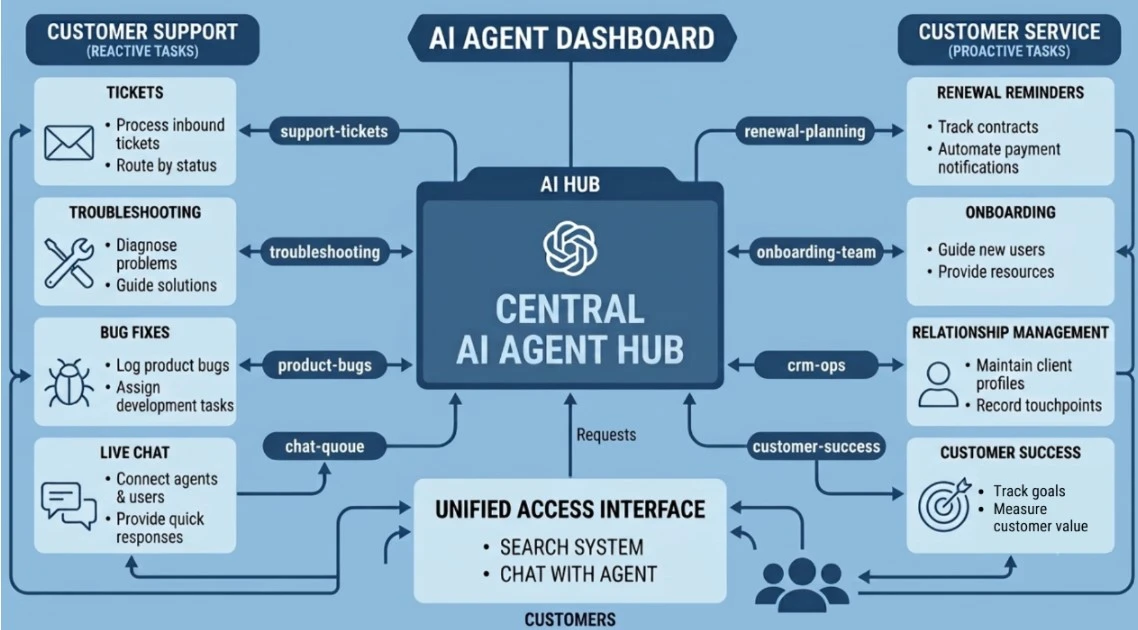
The use of slack-native and conversational ticketing systems brings the fourth element into play. When the tickets are created and solved within the same workspace as used by the client, the differentiation channel between support and services is even more diminished.
The customer may send a support request, receive a proactive message from the CSM, and a summary of renewals – all via one Slack channel, without having to change applications. Systems like Suptask have been built specifically to avoid such issues.
When the Distinction Matters Most and When it Doesn't
Being aware of when this is relevant is key to optimizing internal processes, and awareness of when it is irrelevant will simplify customer interactions.
Use the strict distinction when:
- Hiring the profile for a support engineer and that of a customer success manager are distinct; hire for what you need
- Designing metrics don’t hold a support team accountable for NPS scores, or a CS team for MTTR; there are proper metrics for both functions
- Structuring teams there are different operating models, escalations, and customer support tools for each function
- Writing job descriptions customer support specialist” vs. “customer service manager” gives candidates clues about role differences
Ignore the distinction when:
- Talking to customers they don't think in these categories; match their language
- Naming a software category for general audiences both terms describe the same product category
- Writing public facing content where what the customer calls it is what matters
Recheck the distinction when:
- Scaling past ~20 customer-facing employees the unified model starts to crack and specialization becomes necessary
- Expanding into a new product line with different technical complexity or a different buyer profile
- Adopting AI agents that change who (or what) is handling reactive issues your org chart may need to catch up to your tooling
Conclusion
Customer support vs customer service comes down to scope. Customer service covers the entire customer relationship, while customer support focuses on resolving product or service issues. Although the terms are often used interchangeably, understanding the distinction helps organizations hire the right people, choose meaningful performance metrics, and build support operations that scale effectively. If you're planning your support organization, our guide to customer service desk can help you understand how service desks fit into modern support workflows.
If your team manages customer conversations in Slack or Microsoft Teams, Suptask helps you streamline ticket management, automate workflows, and deliver faster support without leaving your collaboration tools. Explore how Suptask can simplify your customer support operations.
FAQs
What is the difference between support and service?
Customer service is a broad concept that refers to every possible action throughout the process of a customer's journey, both proactive and reactive, before and after purchase. On the other hand, customer support is a narrower concept that is a part of customer service aimed at solving problems related to a product or service.
What is the role of customer support?
The function of customer support is to solve problems that customers face using some particular product or service , usually reactively, via tickets, live chats, emails, or phone calls. It is necessary to help clients derive benefit from something that they have bought already.
What qualifies as customer support?
Customer support includes technical troubleshooting, product onboarding obstacles, troubleshooting errors, any problems related to a particular purchase that relate to billing/access, and instructions after purchase related to product functionality. Customer service or customer success includes sales help, general experiences related to the brand, and ongoing relationship building.
What is the difference between a customer service specialist and a customer support specialist?
The customer service rep will deal with more customer interactions throughout the relationship lifecycle and will be more focused on the communication aspect. The customer support rep will deal with product-related problems and will be more technical in nature – things like debugging, looking at logs, integration problems, etc. In reality, there is an interchangeability between these two roles in most organizations, and the tasks involved vary based on the organization itself.