Customer experience is what defines a brand. It is one of the biggest things that decides whether a customer wants to keep working with you or just leave and go to someone else.
So, how can a brand deliver a good customer experience? This is where a customer experience strategy can help.
A customer experience strategy is an organization-wide plan for delivering consistent, valuable interactions across every touchpoint where a customer meets your brand. Simply put, it is how you decide what experience to give, which customers to give it to, and the touchpoints that matter the most.
So in this post, we will go through what it is, its key elements, how to build one step by step, a few real examples, and how you can improve the one you already have.
What is a customer experience strategy?
A customer experience strategy is the written plan that sets out what experience your company promises to give, and how it will actually deliver it. It usually has a vision of the experience you want to deliver, a definition of your priority customers, the key journeys and touchpoints that matter, a measurement plan, and a governance cadence for who owns it and how often it gets reviewed.
Most businesses think that a CX strategy is the same as a customer service strategy. However, it is not. Service mostly handles support, while CX covers every touchpoint a customer hits, before, during, and after the purchase. A customer success strategy is different again, it focuses on helping customers get outcomes from your product, which is how a customer success strategy differs from CX. Marketing is different too, it makes the promise to the customer, while CX is what delivers on that promise.
Why does a customer experience strategy matter?
Customer experience strategy can help a business with a lot of benefits such as:
- It creates internal alignment: Without a strategy, each team will work to meet their goals, as a result, customers will end up feeling the disconnect between them. A strategy brings the team together, so they can work toward delivering the same experience.
- It forces tradeoffs: You should not emphasize achieving all, like cheapest, fastest, and personalized experience all at the same time. You should choose what resonates with your brand, and strategy helps you to ensure the team works around it.
- It ties experience to business results: A good experience shows up in retention, repeat revenue, and referrals. Furthermore, it is a big part of what drives customer loyalty, since customers stay with brands that treat them well.
The cost of getting this wrong is real. As per PwC's 2025 Customer Experience Survey, 52% of consumers stopped buying from a brand after a bad experience. So a CX strategy is not a nice-to-have, it is what protects the revenue you already have.
Key elements of a customer experience strategy
A customer experience strategy is built from six core elements.
- Customer experience vision: The one-sentence statement of the experience you commit to delivering. It should be specific enough that you can make real tradeoffs against it, something like returns should feel as easy as buying.
- Priority customer definition: Who the strategy is actually built for. A strategy that tries to serve every segment equally usually serves none of them well, so you pick the customers you are optimizing for and let the others get a solid baseline.
- Journey and touchpoint inventory: Every place a customer meets your brand, mapped out and then prioritized. You list the touchpoints from first contact to post-purchase support and work out which ones matter most. This maps onto the customer lifecycle management stages, which break the journey down further.
- Measurement plan: Which metrics you track, at which touchpoints, and with what targets. You should measure the ones that fit, like CSAT, NPS, CES, churn, or repeat purchase, and connect each to a specific moment. These customer engagement metrics each measure something different, so pick purposefully.
- Feedback and improvement loop: How customer signal gets collected, routed to an owner, acted on, and then closed back with the customer. It also defines how you track customer feedback over time so the patterns turn into action.
- Cross-functional ownership: You should structure a CX team, clearly outlining who is accountable for what, and how decisions should be made across teams. CX touches product, support, success, and marketing, so it needs clear ownership rather than being shared by everyone.
How to build a customer experience strategy (step by step)
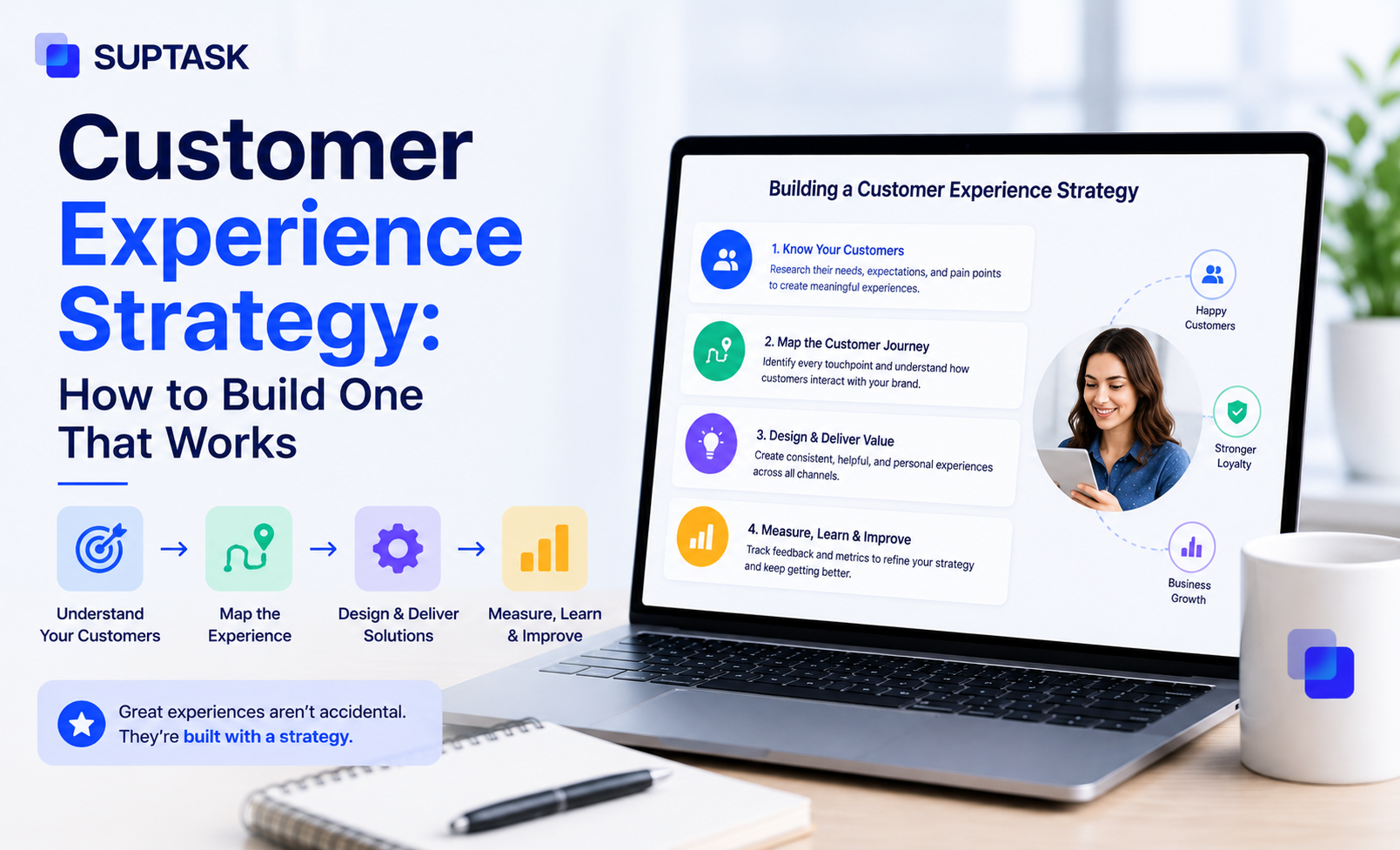
Now that you know the elements, let us see how to actually build the strategy. Some teams build it on top of one of the named CX frameworks worth borrowing from, but a framework is only the structure. The choices inside it are still yours to make.
Step 1: Define the experience you want to be known for
Start with a one-line CX vision that should be specific, so it makes the tradeoffs clear, rather than saying customer-first. For example, refunds should feel easier than purchases; that tells the team what to focus on.
Step 2: Choose your priority customers
If you believe that you can deliver the same experience across every segment, indeed, you can do so, but it will require a lot of effort and time. The best practice would be to decide which customers you want to optimize the experience for, based on their value and fit, and the rest can get a basic but solid baseline. It is a bit uncomfortable, since it means some customers are not your main focus. But if you treat everyone as a priority, then in the end nobody really is.
Step 3: Map the current journey and find the friction
Understand the customer journey from the first point to the support they get after purchasing your product or services. Compare the customer journey and experience across every touchpoint against your vision. The comparison will help you find the points where you are delivering what you promised, and where you need to improve.
Step 4: Set measurement targets
For each priority touchpoint, decide what success looks like in numbers. It can be a CSAT score after a support chat, an NPS movement over a quarter, a churn reduction target, or a time-to-resolution goal for support. Without targets, you will not know if the strategy is actually working. Also, track customer feedback metrics at the touchpoint level, not just company-wide, for a clearer read on what's working.
Step 5: Design the feedback-to-fix loop
This is the operational core of the whole strategy. You decide where the feedback lands, who owns each type of it, and how it moves from collected to actually acted on. A loop with no owner is just a survey. So set it up in a way that feedback gets routed, tracked till action, and then closed back with the customer who raised it. For example, a complaint from a high-value customer gets tagged, sent to the product owner, and the customer hears back once it is fixed.
Step 6: Set a governance cadence
A CX management framework without continuous improvement will do nothing good in the long run. You should have a review system that ensures strategies improve as customer expectations do. So put a cadence in place, like weekly reviews to catch issues fast, monthly reviews to watch the metrics, and quarterly ones to decide if the vision or priorities need a change. Also, have a customer experience team to ensure you have complete accountability on who owns each review and who needs to be there.
Customer experience strategy examples
Some of the world’s leading companies have shown us what customer experience strategy looks like in practice.
Amazon works off a vision of removing friction. The whole experience is built so the customer has to do as little as possible. You see it in one-click ordering, in shipping that often arrives before you expect it, and in returns that happen with almost no questions asked. It is the reason a lot of people default to buying there even when it is not the cheapest option.
Disney parks operate on a different vision, one connected experience across the physical and digital sides. The MagicBand ties your hotel room, park entry, ride bookings, and payments into a single band on your wrist. Add the app showing ride wait times and mobile food ordering, and all of it serves one coherent experience instead of a set of separate services.
Costco shows that a CX strategy is also about what you choose not to do. They do not compete on huge selection or instant delivery. Their vision is closer to trust, you get large quantities, low markups, and a return policy that is helpful to the point of being famous. Customers know exactly what they are getting, and that consistency is the experience.
In all three, the strategy is visible because the touchpoints line up behind one clear choice.
Best practices for a customer experience strategy
Here we have outlined a few best practices for customer experience strategy:
- Write the strategy down: The strategy must be documented to ensure it can be understood by all the team members.
- Make tradeoffs visible: You must have a clear strategy that tells what you are choosing, so the team can put efforts in the right direction.
- Tie every metric to a touchpoint: A single company-wide NPS number mostly creates dashboard fatigue, because nobody knows what to do with it. The same metric measured at a specific point, like right after onboarding, actually tells you what to fix.
- Build the feedback loop before you launch: if feedback collection and routing aren't operational at launch, the strategy can't self-correct. So, you should set up the loop first, so it can learn from real customers from the start.
- Review quarterly, not annually: Customer expectations move faster than most annual planning cycles. A quarterly review keeps the strategy current, instead of letting it drift for a year before anyone looks at it again.
How to improve an existing customer experience strategy?
If you already have a customer experience strategy, the next step is to track and find what is breaking and fixing it. Here is how you can do so:
- The strategy is not being used: This is usually a visibility problem, therefore, the fix is to surface it at the moment decisions actually get made, in product reviews, in support escalation rules, and in roadmap planning, so people reference it instead of forgetting it exists.
- The metrics are not moving: You should have a clear routing path to ensure that each piece of the feedback reaches an owner, and this is where it helps to track customer feedback properly from collection through to action.
- Different teams give customers contradictory experiences: Name an owner for each customer journey, and make the cross-functional review a scheduled thing rather than an occasional chat when something goes wrong.
- The strategy has not been touched in over 18 months: Customer expectations have been changing with each passing. So you should have a quarterly review to ensure your strategy can answer their expectations.
- Executive attention has drifted: Link the CX measures to revenue, churn, or expansion, not just satisfaction scores, and leadership starts paying attention again.
Common pitfalls in customer experience strategy
Here are a few common pitfalls to watch out for with a CX strategy.
- Writing a list of values instead of choices: Rather than using words like trust and care, your strategy must be around the values that actually deliver the results.
- Confusing the strategy with the tools: Indeed, tools are the best way to collect the data, but strategy is what helps you decide what to do with collected data.
- Treating CX as a department: CX is a cross-functional job, every team must work to deliver the experience that defines your organization's values.
- Measuring satisfaction without measuring action: Tracking CSAT or NPS is only half of it. If you never check whether anything actually got done after the feedback, you are only measuring how people feel, not whether anything changed.
Frequently asked questions
What is a customer experience strategy?
A customer experience strategy is an organization-wide plan for delivering consistent, valuable interactions across every touchpoint where a customer meets your brand. It sets out what experience you commit to giving, which customers it is for, and how you will measure and deliver it. In short, it is a written set of choices, not a list of tactics.
What are the key elements of a customer experience strategy?
The key elements are a customer experience vision, a clear definition of your priority customers, a journey and touchpoint inventory, a measurement plan, a feedback and improvement loop, and cross-functional ownership. Together, these turn a vague intention into something a team can actually run and review.
How do you create a customer experience strategy?
You create one by defining the experience you want to be known for, choosing your priority customers, mapping the current journey to find friction, setting measurement targets, designing a feedback-to-fix loop, and putting a review cadence in place. The order matters, since each step builds on the one before it. Give the feedback loop real attention, since it is what lets the strategy correct itself over time.
How is a customer experience strategy different from a customer service strategy?
A customer experience strategy covers every touchpoint a customer meets across the whole brand, while a customer service strategy is narrower and mostly deals with support. Service is one part of the wider experience. So a CX strategy includes service, but also marketing, product, onboarding, and everything else the customer runs into.
How often should you review a CX strategy?
A quarterly review works well for most teams. Customer expectations move faster than a yearly planning cycle, so an annual review usually leaves the strategy out of date. Higher-change businesses may want to watch the key metrics monthly and keep the deeper strategic review quarterly.
What are common reasons CX strategies fail?
CX strategies usually fail for a few reasons: they are written as a list of values instead of real choices, they get confused with the tools that support them, they are treated as one department's job, or they measure satisfaction without checking whether anything actually got fixed. Most failures trace back to one of these rather than to a bad vision.