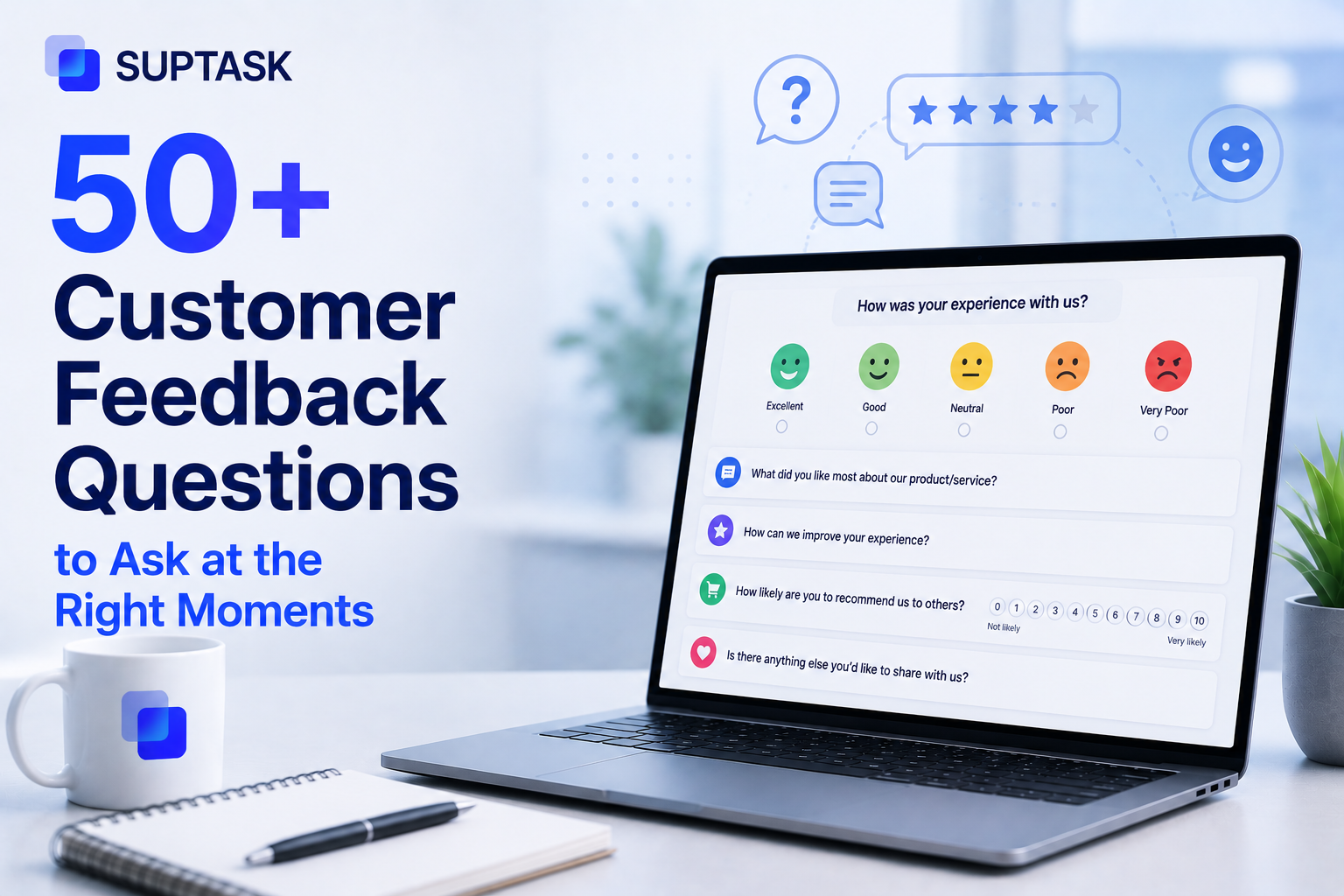
Customer feedback questions are targeted prompts that you can use to measure satisfaction, identify friction points, and find improvements in your product or service. But here is the thing, the questions you pick and the moment you ask them matter a lot more than how many of them you put into one survey.
So in this post, we have organized the questions by the moment you would actually send them, like right after a support ticket closes, during onboarding, or before a renewal, and not by a generic topic.
So, let’s get started.
How to use this list?
Before you start, one simple advice: pick 3, not 30. A short survey often gets answered, while a long one tends to get abandoned halfway through. So do not try to use the whole list at once. Just scan down to the section that matches your moment, whether that is a closed ticket, an onboarding, or a renewal coming up, and take a few questions from there.
One more thing. A good follow-up question, the one that actually asks why, usually tells you more than a perfectly worded main question does.
Core measurement questions (CSAT, NPS, CES)
CSAT (Customer Satisfaction Score)
CSAT measures how satisfied a customer felt with one specific interaction. You can think of it as a transactional metric, so you should send it right after something happens, like a support ticket closing or an order going through, while the experience is still fresh.
The standard question:
- How would you rate your overall satisfaction with the service you received? (rated 1 to 5)
Two follow-up variants:
- What is the main reason for the score you gave?
- What is one thing we could have done better?
NPS (Net Promoter Score)
NPS helps you measure long-term loyalty, beyond the single interaction. Therefore, you should send it periodically, like once a quarter.
The standard question:
- How likely are you to recommend [company] to a friend or colleague? (rated 0 to 10)
Two follow-up variants:
- What is the main reason for your score?
- What would it take to move you closer to a 10?
Scores between 9 and 10 are promoters, 7 to 8 are passive, and 0 to 6 are detractors, which is the part that makes the number mean something.
CES (Customer Effort Score)
CES measures how hard the customers had to work to get something, usually resolving a ticket. Therefore, you send it right after a task or a support resolution, because that is when they can better answer the effort they had to put in.
The standard question:
- [Company] made it easy for me to handle my issue. (rated from strongly disagree to strongly agree)
Two follow-up variants:
- What made it easy or difficult to get your issue resolved?
- Was there a point where you felt stuck?
Questions to ask after a support ticket closes
Once the ticket is marked resolved, you should plan questions around their experience to know their honest feedback. If you leave it a few days, they might face difficulties recalling the experience, or the answers are often vague.
A mix of quick scaled questions and a couple of open ones works best here:
- How satisfied were you with the way your issue was handled? (1 to 5)
- Was your issue fully resolved? (yes / partly / no)
- How would you rate the helpfulness of the agent who dealt with you? (1 to 5)
- How easy was it to get your problem sorted out? (1 to 5)
- How did the resolution time compare to what you expected? (faster / about right / slower)
- Was it solved on the first contact, or did it take more than one go?
- Was the explanation you were given clear and easy to follow? (1 to 5)
- What, if anything, could the agent have done better? (open)
- Is there anything about the fix that still feels unfinished to you? (open)
- What almost made you give up before it got resolved? (open)
If you also measure the performance of the agent's quality over time, then answers to these questions might also be used in their performance review.
You should ask specific questions rather than generic ones, as good feedback is often the result of specific questions.
Questions to ask during onboarding
These questions should be sent when a customer is getting onboarded. These questions will help you find the problems earlier.
- What was your first impression when you started using the product? (open)
- How easy was it to get set up? (1 to 5)
- Was there anything during setup that tripped you up? (open)
- Did the product match what you expected it to do? (yes / mostly / no)
- Was the documentation clear enough to get you going? (1 to 5)
- How long did it take before you got your first useful result out of it? (open)
- Was there something you expected to do first but could not? (open)
Questions to ask before renewal
The following questions should be sent around 60 to 90 days before the renewal date. If you send them closer to the renewal, then you might lose customers as they have already made up their mind.
- Has the product delivered the return you expected when you signed up? (yes / mostly / no)
- How much value would you say you have gotten out of it so far? (open)
- How likely are you to renew when your term is up? (1 to 10)
- What would make you decide not to renew? (open)
- Is there anything missing that would make renewing an easy yes? (open)
- Are there parts of the product you find yourself wanting more of, or more seats for? (open)
- Who else on your team actually uses the product day to day? (open)
Questions like these sit at the center of most customer success strategies, because a renewal rarely turns on price by itself.
Questions to ask when usage drops (churn-risk save)
These are the questions you should send when an account drops below its usual usage, or starts showing early churn signals, like logins falling off or a main user going quiet. You should keep these simple and short, as customers are already not very satisfied with your product or services. A long survey might result in losing them.
- We have noticed you are using the product less lately, has something changed on your side? (open)
- Is there anything getting in the way of using it right now? (open)
- Have your team's priorities shifted since you started with us? (open)
- Have you started using something else to do this instead? (open)
- What would make it worth coming back to? (open)
- Is there anything we could do to help right now? (open)
Questions to ask after shipping a new feature
These questions must be sent to customers who have used your product. You should not send them to your whole list, as those who have not used it might not be able to help you with the feedback.
- How did you come across the feature? Did you find it yourself or did someone point you to it? (open)
- Was it clear what it was for the first time you opened it? (yes/no)
- How useful was it for what you were trying to get done? (1 to 5)
- Did it actually solve the thing you were hoping it would? (yes / partly / no)
- Is there anything about it you would change? (open)
- Would you use it again, or was it more of a one-time thing? (open)
Open-ended questions that pair well with any of the above
These are the questions that can help you with the reason behind the ratings. Therefore, these questions can be sent with any of the questions discussed so far in which you asked customers to rate something.
- What would you change about [the product or feature]? (open)
- What almost stopped you from [signing up, renewing, or finishing the task]? (open)
- What is one thing we could do better? (open)
- What made you pick us in the first place? (open)
- If you could fix one thing right now, what would it be? (open)
- What were you hoping would happen that did not? (open)
- Is there anything we did not ask about that you think we should know? (open)
Common mistakes to avoid
When you work on getting customer feedback, there are some mistakes that are often prevalent across organizations.
The first and most common mistake is the double-barreled question, something like "How was the product and the support?" The problem with such a question is that you can’t predict which question the customer is answering, and eventually any of them remain unanswered.
The second is asking generic questions like "How great was your experience?" That wording encourages people towards a positive answer before they have even thought about it. Keep the framing neutral and ask "How would you rate your experience?" instead.
Vague prompts cause the same kind of trouble. "How was it?" gets you "fine" and nothing else, because it is not anchored to anything. Tie the question to a specific moment, like the ticket they just closed or the feature they just used.
Also, you should not ask too many questions at once. According to SurveyMonkey's research, abandonment often reaches higher once a survey runs past about 7 to 8 minutes, so a long form often loses you the very people you most wanted to hear from. This is the whole reason for picking 3 questions and not 30.
The other most common challenge is collecting the feedback without having a plan to act on it. So when people see that nothing changed after their feedback, the next time they won’t send the feedback.
Where the answers go (and why that matters more than the question)
This is something that matters more than any of the customer feedback questions discussed so far. Even the best question list is wasted if the responses just land in a spreadsheet that nobody opens again. As a result, teams often lose their feedback.
A customer drops a comment in the Slack thread, a couple of team members have seen it, but no one took ownership. The next morning, the comment gets lost in the Slack thread. The comment had a lot of meaningful information, but it was never routed to the right person who can act on it. This is how customer feedback loses its value, but none of the process doesn't change.
So, beyond these questions, you should work on having a system to track customer feedback and own tickets, rather than just discussing it. If your team already runs these conversations in Slack, Suptask can turn those threads into tickets that someone actually owns and follows up on, so a piece of feedback does not vanish just because the channel moved on.
If that sounds like where your feedback keeps getting lost, it is worth seeing how a Slack-based ticketing workflow holds onto it.
Frequently asked questions
What are good questions to ask a customer for feedback?
Good questions to ask a customer are specific ones tied to a real moment, not broad ones like "How are we doing?" A solid set covers how satisfied they were, whether their issue was actually resolved, how much effort it took them, and one open question asking what you could do better. The trick is to match the question to the trigger, so a question sent after a support ticket looks different from one sent before a renewal.
What are 10 good questions to ask customers?
A workable set of 10 mixed scores and open answers. You might ask how satisfied they are (1 to 5), how likely they are to recommend you (0 to 10), whether their issue was resolved, how easy it was to get help, what their first impression was, whether the product matched expectations, what almost stopped them from buying, what they would change, what one thing you could do better, and whether anything still feels unfinished. Pick from the sections above depending on the moment, you do not send all 10 at once.
What are some feedback questions?
Some common feedback questions are "How satisfied were you with your experience?", "How likely are you to recommend us?", "What could we have done better?", and "Did this actually solve your problem?". These work across most situations because they are simple and neutral. Add an open follow-up to any of them, and you get the reason behind the answer, which is usually the part worth having.
What are 5 good customer survey question examples?
Five good survey questions to start with: How would you rate your overall satisfaction? (1 to 5), How likely are you to recommend us to a colleague? (0 to 10), How easy was it to get your issue resolved? What is the main reason for your score? And what is one thing we could do better? Together, they give you a score, a loyalty signal, an effort read, and the reasons sitting behind all three.
How many questions should a customer feedback survey have?
Fewer than you would think. Three to five focused questions is usually the sweet spot, because response rates start falling once a survey runs past about 7 to 8 minutes. It is better to ask three questions people actually finish than thirty that get abandoned halfway.
When should you send a customer feedback survey?
Send it close to the moment you are asking about, while it is still fresh. A CSAT survey goes right after a ticket closes, an onboarding survey a little way into setup, and an NPS survey every quarter or so rather than after every interaction. If you collect a lot of feedback this way, it helps to have a system like Suptask that routes each response to an owner, so the answers do not pile up unread.