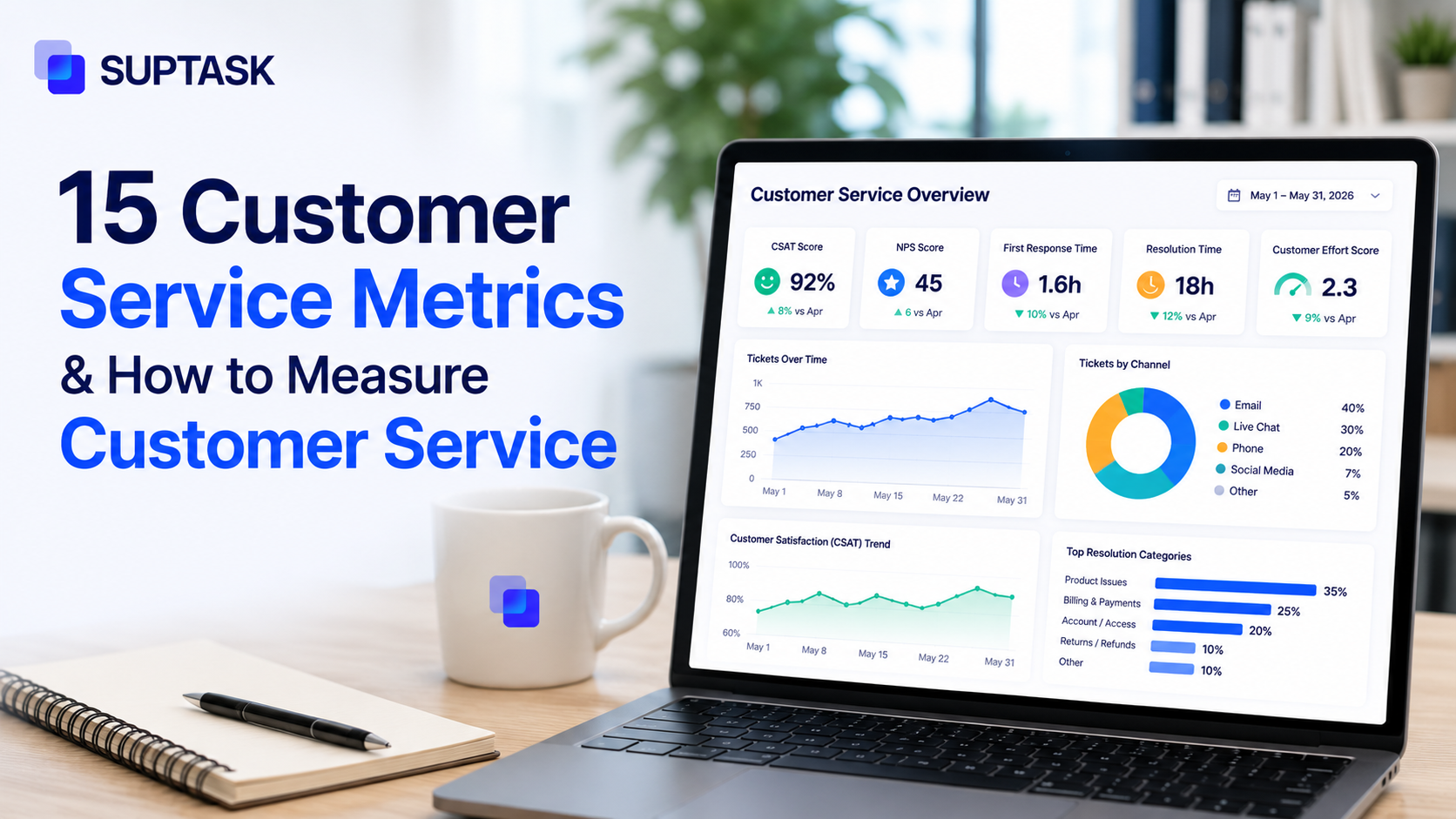
Measuring customer service well needs two things, the right metrics and the discipline to act on what they show. In this blog, you will find 15 customer service metrics organized by category, along with guidance on which ones to track based on your team size and priorities. One suggestion before you start reading, most teams should begin with 5 metrics from this list and not all 15.
Here are the core customer service metrics that most teams track:
- First response time (FRT): How quickly your team replies to incoming requests
- First contact resolution (FCR): Share of issues resolved on the first interaction
- Average resolution time (ART): How long it takes to fully close a ticket
- Customer satisfaction score (CSAT): Direct customer rating after an interaction
- Net promoter score (NPS): How likely the customer is to recommend you
- Customer effort score (CES): How easy the customer felt the interaction was
- SLA compliance rate: Percentage of tickets resolved within the service-level targets
- Ticket volume: Total inbound requests in a period
- Self-service deflection rate: Share of issues resolved without an agent
- Cost per ticket: The fully-loaded cost of handling each ticket
What are customer service metrics?
Customer service metrics are the quantitative measures of how well your support function is performing. They cover the speed of responses, quality of resolutions, customers' perception of the interaction, performance of individual agents, and the business outcomes behind all of it.
People often mix them up with other categories that sound similar to customer service metrics. CX metrics work at the journey level and cover everything a customer experiences with your brand. The customer engagement metrics focus on loyalty and behavior, such as how often customers return and how deeply they use what they bought. Product metrics track in-product usage.
Customer service metrics are more limited than all three, they measure the support function specifically, and that narrowness is what makes them actionable for a support manager.
One thing to remember before going through the catalog. Metrics are a means and not the end. Tracking numbers that nobody acts on is reporting overhead, so this post focuses on which metrics matter for your team and what to do when they move.
How to measure customer service?
Knowing how to measure customer service is a separate skill from knowing the metrics, and most measurement programs fail at the process rather than at the math. Follow these five steps in order.
- Define what good service means for your team: Start with the customer outcome you want, whether that is faster resolutions, higher satisfaction, or repeat purchases, and only then pick the numbers that measure it. Metrics chosen without an outcome behind them become reporting noise within a quarter.
- Pick 5 to 8 metrics that map to that outcome: Begin with a small set of key performance metrics for customer service, reviewed properly, rather than ones that no one measures. You can add more as you grow.
- Set baselines before targets: Measure your current performance for at least 30 days before committing to any improvement target. Without the baseline, you do not know whether "improve CSAT by 10%" is ambitious, trivial, or impossible.
- Put the metrics where decisions get made: A metric living in a separate tool that nobody opens is a metric not being tracked, whatever the reporting says. Look at some CX dashboard examples to see how teams surface their numbers inside the daily workflow instead of beside it.
- Review on a cadence and adjust: Weekly for the operational numbers, monthly for reviewing the metric set itself, quarterly for the strategic view. The metric set is not permanent, drop what you cannot act on and add what the next stage needs.
15 customer service metrics organized by category
Here is the full catalog. Five categories, 15 metrics, and we have kept each one short on purpose, a metric definition should not need an essay.
Response and resolution metrics
1. First response time (FRT)
First response time (FRT) refers to the waiting time before your team’s first reply. Average it per period and split it by channel.
The ideal FRT for chat customers should be within a minute, and for email, the 2026 benchmarks are under4 hours as competitive, with 24 hours as the baseline for non-urgent tickets.
2. First contact resolution (FCR)
FCR is the share of tickets resolved in the first interaction, with no follow-up needed from the customer.
You can calculate it by dividing first-touch resolutions by total tickets. Customers who never come back for the same issue stay the most satisfied, so FCR is directly proportional to the CSAT score.
3. Average handle time (AHT)
As the name says, it helps to measure the active working time of an agent per interaction. You can calculate it simply by dividing the total working time by the number of interactions.
You should not set aggressive AHT targets, as it might lead agents to start closing tickets half-done, ultimately leading to a reduction in the FCR score. Also, you should keep the research time and waiting time outside AHT, so complex tickets always cost more than it shows.
4. Average resolution time (ART)
Average resolution time (ART) is the time between ticket open and close, including the waiting. This is the metric that often matters to customers. Compare it with AHT from time to time, and if the gap is wide, your tickets are stuck waiting somewhere, in escalations, with other teams, or in research.
5. SLA compliance rate
Every organization has some target rate, and SLA compliance rate is the way to measure it. It helps you know the number of tickets that meet a certain target for that channel and priority.
You can calculate this by dividing compliant tickets by total tickets. Simple enough. The trouble is the targets, most of them were set during the help desk setup and never touched again.
Volume and throughput metrics
6. Ticket volume
It refers to total inbound requests in a period. It will help you with per-agent capacity planning, per category for finding which product area hurts, per hour of the day for staffing gaps. So, you can ensure the productivity of the customer service team.
7. Backlog size
Backlog means the unresolved tickets right now, segmented by age, checked daily. A growing backlog means a capacity problem ahead. A shrinking backlog is usually good, unless agents are closing tickets that should stay open, so verify. You can pair it with SLA breach age, since the backlog itself does not know which tickets are urgent.
Customer satisfaction metrics
CSAT, NPS, and CES come from the broader customer engagement metrics family, and help you know how satisfied customers are with your customer service.
8. Customer satisfaction score (CSAT)
CSAT is the customer's rating right after an interaction, mostly on a 1 to 5 scale. You should measure it per ticket, rather than an aggregate score. Also, never read it without the response rate, a 95% score from a 4% response rate deserves less trust than an 85% score from a 40% one, because you are only hearing from the customers who bothered to answer.
9. Net promoter score (NPS)
How likely are you to recommend us, 0 to 10, promoters minus detractors. Although, it is a CX metric that should be measured cumulatively across the whole customer lifecycle, beyond just customer service. However, if customer service has a significant part in it, you should measure it too.
10. Customer effort score (CES)
How much effort did the customer feel they spent, usually on a 1 to 7 scale. The more effort customers have to make to reach a resolution, the more frustrating the experience will be for them. Therefore, you should ask customers "how much effort did you put in?" and "How easy was it?"
Agent performance metrics
11. Agent utilization
This metric is helpful to measure the productivity of an agent. You can calculate it simply by dividing productive time by the scheduled time.
The score above 85% for long stretches, expect burnout and quality drops. Under 60%, look at staffing levels or the workflow. Utilization cannot tell whether the right work is happening, an agent at 90% on easy tickets while the hard ones age in the queue is not a productivity story. Using this number in customer service performance reviews needs its own care.
12. Quality assurance (QA) score
A reviewer scores sampled interactions against a rubric, and the average becomes the QA score. The rubric is everything here. A weak rubric measures the wrong things precisely, and agents optimize toward it. The reviewer also sees only the recordings and written replies, while the real judgment calls, escalating at the right moment or bending a policy sensibly, happen off the record.
Business and channel outcome metrics
13. Cost per ticket
All your support costs, salaries, tooling, infrastructure, overhead, divided by the tickets handled. Executives read this one first, and AI deflection moves it fastest. Keep CSAT beside it always, otherwise, the savings you report may have been paid for by the customer experience, and that bill arrives later as churn.
14. Self-service deflection rate
Issues resolved with no agent involved, through the knowledge base, chatbot, in-product help, or an AI agent, divided by all customer issues. The customer support automation software you run decides most of it. The rate cannot tell whether deflected customers solved anything or gave up, so add a post-deflection survey or watch how many tickets appear right after self-service attempts.
15. Channel abandonment rate
Chats or calls dropped before an agent connects, counted per channel. Above 5 to 10%, investigate. Investigate is the keyword, long waits cause abandonment, and so do IVR mazes and confusing self-service paths. More staff fixes only the first of those causes.
How to choose which metrics matter for your team?
The best practice is to start with the metrics that matter to you, instead of tracking all 15 from the first day. Choosing the metrics depends on your team size, and the rest gets added in stages as the team grows.
- Under 10 agents, five metrics are enough: FRT, FCR, CSAT, ticket volume, and backlog size. These 5 metrics will help you learn how quickly you respond, resolve issues, and customer satisfaction score, along with the load your team has.
- Between 10 and 50 agents, add four to that base: AHT, SLA compliance, agent utilization, and cost per ticket. At this size the operational questions get complicated, and the leadership starts asking what the support function actually costs, so you want the cost visibility ready before that question arrives.
- Crossed 50 agents? Bring in the remaining six: ART, CES, NPS, QA score, self-service deflection rate, and channel abandonment rate. A program of this size usually has a dedicated support ops person, and these six give that person the depth an enterprise measurement program needs.
One rule applies at every size, though. If a metric moves and your team cannot do anything about that movement, drop it, because it is only reporting overhead at that point. Reviewing six numbers and acting on them gives better results than staring at a dashboard of thirty.
Common mistakes when measuring customer service
Here we have compiled a list of the most common mistakes you might face when measuring customer service metrics.
- Tracking everything, acting on nothing: You might have a dashboard to track everything metric, but no action plan to act on them. If this is the case, then it is equivalent to tracking no metrics. The best practice is to start with the one you can act upon, and start tracking more as you grow.
- Reading speed as quality: Every metric is equally important, but alone they won’t reveal the complete picture. For example, FRT tells you how fast the reply went out, but it does not tell you whether the customer got helped by that reply. So, you should use them with relevant metrics to have a complete understanding.
- Trusting a biased survey: A CSAT score built from a 5% response rate is sampling the customers who felt strongly enough to answer, and mostly that means the unhappy ones or the delighted ones. The quiet majority never enters your number.
- Optimizing one metric while another one pays: Push AHT down and the FCR usually follows it down. Push cost per ticket down, and the CSAT often goes with it. The metrics are connected, so review them together instead of assigning each one to a different owner.
- Setting targets without a baseline: "Improve CSAT by 10%" means nothing when nobody knows the current rate or how much it moves naturally from month to month. Measure for 30 days first, then set the target.
Frequently asked questions
What are customer service metrics?
Customer service metrics are the quantitative measures of how well a support function performs, covering response speed, resolution quality, customer perception, agent performance, and business outcomes. They are narrower than CX or engagement metrics, and that narrowness is what makes them actionable for a support manager.
What are the 4 key metrics of customer service?
First response time, first contact resolution, CSAT, and average resolution time. Between these four, you can see how fast the team replies, how often issues get solved in one interaction, how the customers feel about it, and how long the full resolution takes.
What are the 5 key performance indicators for customer service?
FRT, FCR, CSAT, ticket volume, and backlog size. This is the starter set we recommend for teams under 10 agents, since it covers speed, quality, satisfaction, and operational load with very little tracking overhead. Larger teams add more on top of this base.
What are the 5 key CX metrics?
NPS, CSAT, CES, churn rate, and customer lifetime value. Note that these measure the customer experience across the whole journey, not the support function specifically. Only CSAT and CES overlap heavily with the day-to-day service measurement.
How do you measure customer service effectively?
Define what good service means for your team first, then pick 5 to 8 metrics that map to that outcome. Measure a 30-day baseline before setting any targets, put the numbers where decisions get made, and review them on a fixed cadence. Tracking more metrics than you can act on reduces effectiveness rather than adding to it.
How often should customer service metrics be reviewed?
Weekly for the operational numbers like FRT, backlog, and SLA compliance. Monthly for reviewing the metric set itself, and quarterly for the strategic view. A metric that nobody reviews on a cadence is not being tracked, whatever the dashboard says.