Support teams usually don’t start looking for the best online ticketing system because they want more software. They start looking when customer messages get buried, requests go unanswered, and important issues slip through the cracks.
The problem is that each ticketing platform is built differently. Some tools are built for large IT departments with approvals and complex workflows, while others focus on simple customer support management. What works well for one team may be too complex or too restrictive for another.
That’s why the right ticketing system depends on how your team works each day. Whether you’re replacing spreadsheets, moving beyond a shared inbox, or just organizing internal requests, the best solution is the one that fits your workflow and support needs.
How We Evaluated These Top IT Ticketing Systems
A ticketing system can look impressive in a demo but become frustrating after rollout. To avoid that, we evaluated tools using practical operational criteria instead of feature checklists alone.
Ease of setup
How long does it usually take your team to go from sign up to live tickets? Some tools take a day to set up. Others take weeks of workflow design, admin training and help with implementation. It's better for smaller IT teams to have simpler onboarding and lower admin overhead.
Channel coverage
Can tickets come in via email, chat, Slack, a self-service portal, and an API? Modern online ticketing software requires multiple intake channels. The right channel mix is dependent on whether your requests are internal or customer-facing.
Automation and AI
AI is now standard across most ticketing platforms, but implementation quality varies widely. We looked at AI-assisted triage, automated routing, summaries, suggested replies, and workflow automation.
Reporting and visibility
Managers need to see SLA performance, response times, ticket volume, and workload trends. And internal IT and operations teams with multiple service categories need strong reporting even more.
Integration ecosystem
When you tie a ticketing platform to identity providers, CRMs, asset systems, developer tools, and collaboration platforms it becomes more useful. Integrations are what make a ticketing system fit into your workflow, rather than fight it.
Pricing transparency
Many vendors advertise low entry pricing, with key features behind expensive enterprise tiers. We preferred tools with more transparent pricing, no hidden costs and realistic scaling expectations.
How to Choose a Ticketing System: A Decision Framework
A ticketing system is not about the number of features but about your workflow, team size, and support complexity.
Before you compare tools, narrow your options with these four questions.
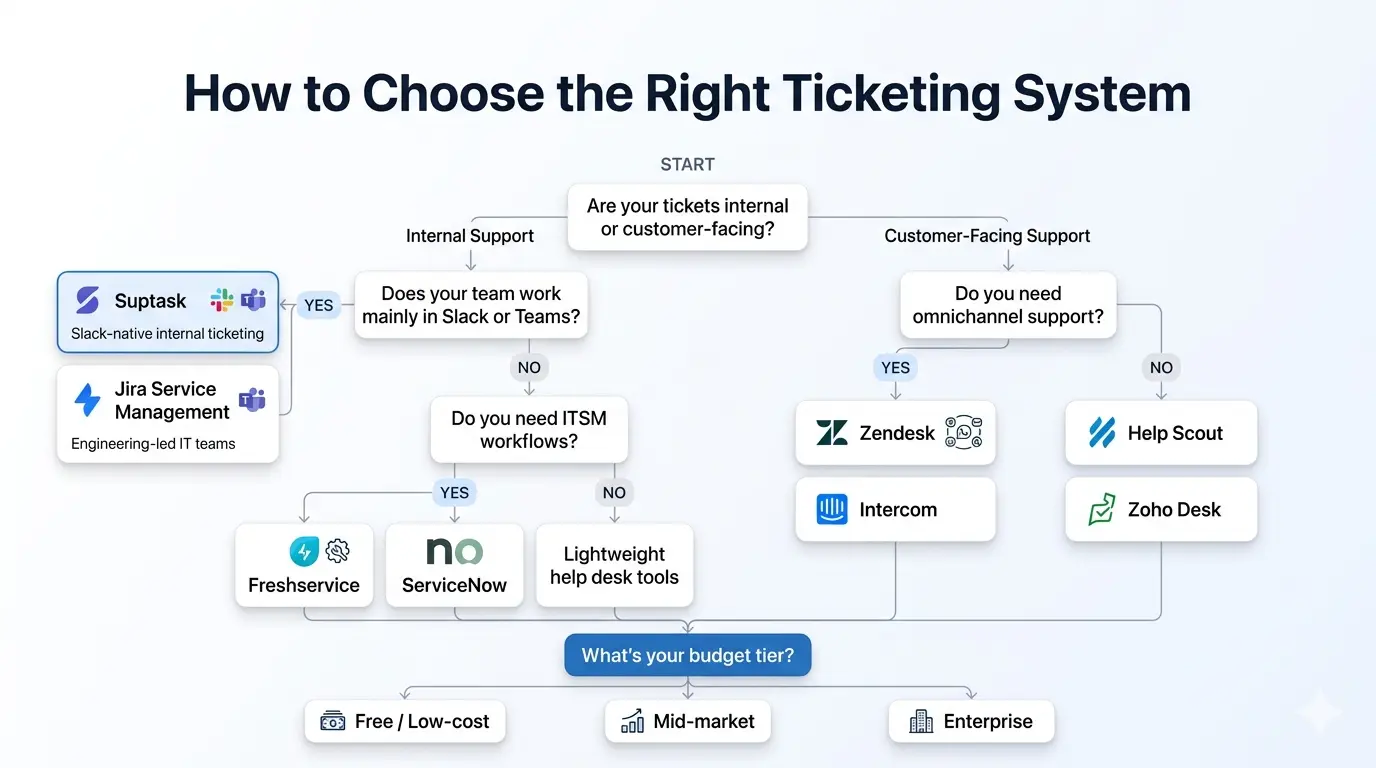
1. Are your tickets internal or customer-facing?
Internal support teams usually need:
- Employee request management
- Approvals and escalations
- Slack or teams collaboration
- It workflows and SLA tracking
Tools like Suptask, Freshdesk service, and Jira Service Management are stronger fit for internal IT and operations teams.
Customer-facing support teams usually prioritize:
- Email, chat, and social support
- Omnichannel communication
- Customer history and CRM data
- Ai support agents
Zendesk, Intercom, Help Scout, and Zoho Desk are built more for external customer conversations.
2. Does your company already work in Slack or Microsoft Teams?
Some ticketing systems still rely on portals and email queues. Others are designed for chat-first collaboration.
If your employees already work heavily in Slack, forcing them into another system can reduce adoption and slow response times.
Platforms like Suptask and Jira Service Management allow teams to:
- Create Tickets Directly Inside Slack
- Manage Requests In Channels
- Reduce App Switching
- Keep Conversations And Tickets Connected
Traditional customer support tools like Zendesk and Intercom are still stronger for omnichannel communication across email, chat, and social.
3. Do you need ITSM workflows?
Not every company needs enterprise-grade ITSM software.
You likely need advanced ITSM functionality if you require:
- Change Management
- Asset Management
- Cmdb Support
- Incident And Problem Management
- Compliance Workflows
Freshservice and ServiceNow are designed specifically for structured ITSM environments.
Jira Service Management also works well for engineering-led IT teams already using Jira and Confluence.
If your workflows are simpler, lighter tools are usually easier to deploy and maintain.
4. What’s your realistic budget?
Ticketing software pricing scales quickly once you add automation, AI, reporting, or enterprise workflows.
For startups
- Suptask
- Spiceworks
For small businesses
- Zoho Desk
- Help Scout
- HubSpot Service Hub
For mid-sized businesses
- Zendesk
- Freshservice
- Jira Service Management
For enterprise businesses
- Intercom
- ServiceNow
The best ticketing software is the one your team will actually adopt and use consistently but not necessarily the platform with the longest feature list.
The Best Ticketing Software, By Use Case
Choosing the right ticketing software depends more on your workflow than the total number of features. Some platforms are built for Slack first internal support, while others focus on customer service, enterprise ITSM, or low-cost shared inbox workflows.
Grouping tools by use case makes it easier to compare platforms that solve similar problems.
Best Ticketing System for Startups
Startups need a free ticketing system or lightweight platform that is quick to deploy and easy to learn. The right solution should minimize costs while helping small teams stay organized as customer requests increase.
Suptask
Suptask is a Slack-native ticketing system for every team that handles internal requests, from IT and HR to operations, with structured workflows that never leave Slack.
Best for:
Internal support teams are already operating heavily inside Slack.
Key features
- Create and manage tickets directly inside Slack
- AI-powered routing and automation
- SLA tracking and internal reporting
- No separate employee portal required
Pricing
Starting at $18/agent/month (as of May 2026).
No Free tier
Watch-outs
Best suited for Slack-first organizations. Teams needing advanced external customer support channels may need a broader omnichannel platform.
Spiceworks
Spiceworks provides a free IT help desk for small teams that need basic ticketing without licensing costs.
Best for:
Small IT teams with little or no software budget.
Key features
- Unlimited tickets and end users
- Community support ecosystem
- Simple IT help desk workflows
- Free core platform
Pricing
Core platform is permanently free (as of May 2026). Premium plans start at $6/agent/month.
Watch-outs
The free version includes ads and lacks some polish compared to commercial competitors.
Best Ticketing System for Small Business
Small businesses need software that's easy to deploy, affordable, and simple to manage. The best ticketing system for small business helps teams organize customer requests, automate repetitive tasks, and improve response times without requiring dedicated IT administrators. These tools offer the right balance of functionality, pricing, and ease of use for growing businesses.
Help Scout
Help Scout is a lightweight support platform that combines a shared inbox, docs, and chat without enterprise complexity.
Best for:
Small and mid-sized support teams wanting a simpler inbox-style workflow.
Key features
- Shared inbox with collision detection
- Knowledge base and docs tools
- Live chat support
- Fast onboarding for agents
Pricing
Starting at $25/user/month on annual plans (as of May 2026).
15-day free trial available with no credit card required.
Watch-outs
Less suitable for advanced ITSM workflows or heavily customized enterprise processes.
Zoho Desk
Zoho Desk offers affordable multichannel support with built-in AI features and strong free-tier availability.
Best for:
SMBs wanting low-cost omnichannel customer support.
Key features
- Email, chat, and social support
- Zia AI for tagging and sentiment analysis
- Workflow automation
- Free plan for small teams
Pricing
Starting at $5–$6/agent/month on annual plans (as of May 2026).
Free plan available for up to 3 agents. 15-day free trial available.
Watch-outs
Advanced customization and reporting are more limited than enterprise focused platforms.
HubSpot Service Hub
HubSpot Service Hub connects ticketing directly with HubSpot CRM, sales, and marketing data.
Best for:
Teams already using HubSpot CRM across their customer operations stack.
Key features
- Shared CRM customer records
- Ticket pipelines and automation
- Knowledge base and customer portal
- Free starter tools
Pricing
Free tier available. Paid plans start at $10/seat/month (as of May 2026).
Watch-outs
Standalone ticketing depth is lighter than dedicated ITSM or enterprise support platforms.
Best Ticketing System for Mid-Sized Business
As support operations become more complex, businesses need a help desk ticketing system with automation, SLA management, reporting, and integrations. These platforms are built for organizations that manage larger ticket volumes across multiple departments while maintaining consistent service quality.
Zendesk
Zendesk is a mainstream customer support platform built for omnichannel communication and large-scale support operations.
Best for:
Mid-market and enterprise customer support teams.
Key features
- Unified email, chat, voice, and social inbox
- AI-powered support automation
- Knowledge base and self-service tools
- Large integration marketplace
Pricing
Starting at $19/agent/month for Support Team plans (as of May 2026). Suite plans start from $55/month.
14-day free trial available.
Watch-outs
Advanced automation, AI, and reporting features can significantly increase total pricing as teams scale.
Freshservice
Freshservice is an ITSM-focused platform built for structured internal support and IT operations.
Best for:
IT help desks needing ITIL-aligned workflows and asset visibility.
Key features
- Built-in asset management and CMDB
- Change, problem, and release management
- Workflow automation
- Self-service support portal
Pricing
Starting at $19/agent/month annually or $29/month on monthly billing (as of May 2026).
14-day free trial available.
Watch-outs
Can feel overly operational for teams that only need lightweight ticket management.
Jira Service Management
Jira Service Management is a modern ITSM platform that works especially well for technical organizations.
Best for:
Engineering-led IT and operations teams.
Key features
- Incident and request management
- AI virtual agent
- Deep Atlassian integrations
- Automation and approvals
Pricing
Free for up to 3 agents. Paid plans start at $20/agent/month (as of May 2026).
7-day free trial available.
Watch-outs
The interface and workflow setup can be intimidating for non-technical departments.
Best Ticketing System for Enterprise Business
Large organizations require an enterprise ticketing system that supports governance, security, compliance, and highly customized workflows. These platforms are built to manage complex service operations across multiple teams, locations, and business units.
Intercom / Fin
Intercom focuses on AI-first customer communication with in-app messaging and automated support workflows.
Best for:
Product-led SaaS companies wanting conversational AI support.
Key features
- Fin AI agent for automated resolutions
- In-app messaging and onboarding
- AI-assisted workflows
- Conversational customer support
Pricing
Starting at $29/seat/month (as of May 2026). Fin AI usage is billed separately at $0.99 per resolution.
14-day free trial available.
Watch-outs
Real-world costs can increase quickly once AI usage and automation volume grow.
ServiceNow
ServiceNow is the enterprise standard for large-scale ITSM and workflow automation.
Best for:
Large organizations with mature governance and service management requirements.
Key features
- Enterprise-grade ITSM workflows
- Advanced automation platform
- Change and incident management
- Custom app development via Now Platform
Pricing
Custom quote-based pricing (as of May 2026). Enterprise deployments commonly range from $100–$300+ per user/month depending on modules.
No self-serve free trial available.
Watch-outs
Implementation complexity and ownership costs are significantly higher than most mid-market alternatives.
When You DON’T Need a Ticketing System (Yet)
Not every team needs a dedicated ticketing platform immediately.
If your company has fewer than 10 people handling a relatively low volume of requests, a shared inbox or Slack channel may work perfectly fine for now.
At an early stage, simplicity often matters more than process. Many small teams successfully manage requests through:
- Shared support inboxes
- Slack channels
- Lightweight forms
- Simple task managers
The problem usually starts when request volume grows.
Common signs you’ve outgrown informal workflows include:
- Requests getting lost in dms or email threads
- No clear ownership of tasks
- Repeated follow-up messages asking for updates
- Difficulty tracking response times
- Zero visibility into workload or ticket volume
That’s typically the point where a ticketing system becomes valuable.
For teams already operating heavily in Slack, jumping straight into a large ITSM platform can feel unnecessary. Lightweight tools like Suptask work well as a middle step, adding structure, ownership, and reporting without forcing employees into a completely separate portal or workflow.
Instead of replacing Slack, the system works inside it, which usually makes adoption easier for growing internal teams.
Final Thoughts
The best ticketing system comes down to three things: who you support, where your team already works, and how complex your workflows really are.
Customer-facing teams often have an edge when it comes to omnichannel platforms like Zendesk or Intercom. Internal IT and operations teams often require more strategic collaboration, SLA tracking, and ITSM workflows using tools like Freshservice, Jira Service Management, or ServiceNow. Lightweight platforms like Suptask provide a simpler way to add structure without forcing Slack-first companies and their teams into another portal.
The goal isn't to pick the platform with the most features, but rather the one your team will actually use consistently.
FAQs
What is a ticketing system?
A ticketing system is software that helps teams manage, organize, and track support requests. Each request becomes a “ticket” that can be assigned, prioritized, updated, and resolved through a structured workflow. Ticketing systems are commonly used by IT teams, customer support departments, HR, and operations teams to improve visibility and response times.
What’s the difference between a help desk and a ticketing system?
A ticketing system mainly focuses on tracking and resolving requests. The best IT help desk software usually includes additional support tools like knowledge bases, automation, customer communication channels, reporting, and self-service portals. In practice, many modern help desk platforms also include ticketing functionality as part of a broader support suite.
What is the best free ticketing system?
The best free ticketing system is dependent on your team size and workflow. Spiceworks is a free IT help desk ticket system for small teams. Zoho Desk and HubSpot Service Hub both have free tiers with basic support features. Suptask also offers a free plan for lightweight ticket management for Slack-first internal teams.
Is Jira a ticketing system?
Yes. Jira Service Management is a ticketing and ITSM platform for IT, engineering, and ops teams. It includes request management and incident ticket tracking software, approvals, automation and SLA reporting. Many companies are already using Jira Software and Confluence and select it because it offers deep integration with the Atlassian ecosystem.
What’s the best ticketing system for small businesses?
Small businesses tend to favor tools that are easy to set up and cheap to maintain. Popular customer support options include Zoho Desk, Help Scout and HubSpot Service Hub. Suptask is a good option for small internal teams already using Slack. The best choice depends on whether your tickets are customer facing or internal.
What’s the best IT ticketing system?
Freshservice and Jira Service Management are solid mid-market options for structured IT service management. ServiceNow is typically used by large enterprises with sophisticated governance requirements. Teams that handle mostly internal requests in Slack may prefer lightweight best ticketing platforms like Suptask over full-blown enterprise ITSM software.