A customer experience team is the group responsible for how a company designs, measures, and improves the customer journey across every touchpoint, from awareness through renewal.
Support, service, and success teams each handle part of that journey, and the CX team is the one accountable for the whole of it. Therefore, it is necessary to structure the CX teams the right way, because an unorganized team often ends up accountable for outcomes it cannot control.
Here in this article, you will find the definition of a customer experience team, its core responsibilities, three operating models, the roles worth hiring, five maturity stages, and how to build the team.
So, let’s get started.
What is a customer experience team?
A customer experience team works as the operating system that turns customer-centricity into repeatable execution. Companies keep saying that customers come first. But saying it is easy, and most companies have no working setup behind the claim. The CX team is that setup.
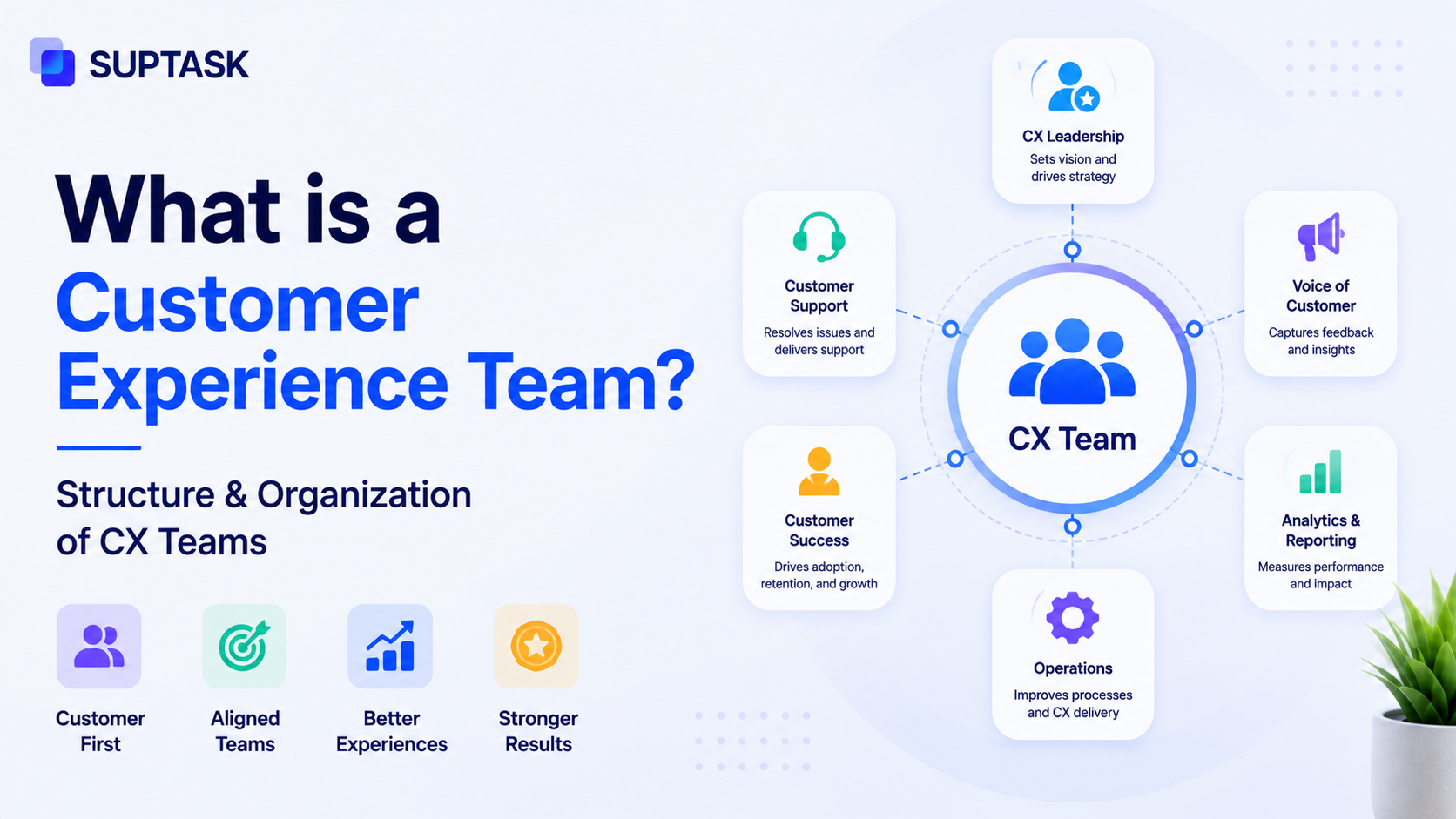
The team owns the end-to-end journey. This means the full path a customer takes, starting from the first touch and going all the way to renewal or a repeat purchase. Sales sees its own part of this path, support sees another part, and the CX team is the one holding the complete picture. The team also owns the listening architecture, which is basically how feedback enters the company. Surveys, support tickets, product usage signals, reviews, all of it. Then comes the taxonomy. Feedback needs to be categorized in a shared language, because a complaint tagged by a support agent should mean the same thing when the product team reads it later. And on top of these three, the CX team is responsible for getting product, support, sales, and marketing to act on what customers are saying. Indeed, insights change nothing until some team actually picks them up.
However, do not confuse a CX team with the support team. Renaming your customer service department will not create a CX function. What you get instead is confusion about who owns the strategic work. A customer success team is also not the same thing, though the two overlap in some org models. We will get to those boundaries later in this article.
What does a customer experience team do?
A customer experience team spends its time keeping the customer journey measured and governed, and making sure the improvements that come out of all that measurement actually reach the customer. If we break this mandate down, it comes to five responsibilities.
- The customer journey map: Working with the sales and support teams to map how customers move from first contact to renewal. Each one might have a different journey. A CX team is responsible for keeping one official map that all these teams agree on and contribute to, covering awareness, purchase, onboarding, daily use, and everything that comes after.
- The listening system: There is no definitive source for the feedback. It might arrive from surveys, support tickets, product usage data, and reviews, and someone has to decide how all of it gets tagged and how feedback gets routed and acted on. For instance, a spike in tickets about invoices should reach the billing team within days and not sit in a quarterly report. The CX team ensures that the feedback reaches the right team irrespective of the source it is coming from.
- Experience standards: Every touchpoint needs a written answer to what the customer should get there and what tradeoffs the company accepts, say a slower first response for customers on the cheapest plan. Writing these standards down falls to the CX team’s responsibility.
- Measurement: The team owns NPS, CSAT, CES, and the journey-level scores. It also has to connect these numbers with retention, expansion, and churn.
- Cross-functional governance: When a decision affects customers, the CX team gets product, support, sales, and marketing into the same conversation to ensure an informed decision is taken. While the execution of that decision stays with the individual teams.
So, a CX team has responsibilities from owning journey standards, the listening architecture, and the feedback taxonomy outright. It influences product changes, policies, and frontline staffing, however it does not execute any of them. Therefore, it should never own ticket resolution, retention quotas, or feature delivery, since those belong to support, sales, and product.
CX team vs customer support vs customer success
People often use these terms interchangeably, however, they are not the same.
The customer support team is the one that acts when a customer reports a problem. The team has reactive work, and it has to be, since nobody can predict which ticket comes in next from which customers.
The performance of the support team is measured by how fast it responds and resolves the issues with the help of key metrics such as FRT, FCR, CSAT, and SLA compliance. These metrics also explain the difference between customer support and customer service, since the two teams get treated as one in many companies while their work is not the same.
Customer success is a preventive team that doesn’t wait for a problem report. It works with customers throughout the whole lifecycle to help customers get value out of the product. It helps companies with customer retention, expansion, account health, and more. This is also the reason customer success roles and responsibilities are organized around accounts and lifecycle stages, while support roles are organized around the queue.
A customer experience team is the one looking at all of it together. It does not resolve the ticket, and it does not manage the account either. What it does is learn why customers keep facing the same problems and redesign the journey so those problems stop appearing. Some companies call it the customer experience department, and its measures are journey-level scores and the business outcomes connected to them, reviewed weekly to monthly.
However, if you are a small company, do not rush to build three separate teams. One person handling all three works fine until the volume demands specialization.
Customer experience team operating models
There is no single right way to structure a customer experience team. It depends on the size of the company, its stage, and how much authority the leadership is ready to give to the CX function. Based on these factors, a CX team can be structured around the following 3 operating models. So, before deciding how to structure a customer experience team, you should understand these three models and where each one fits.
Centralized model
The centralized model refers to having a dedicated CX team that reports to a Chief Customer Officer or a VP of CX. The team has complete ownership of customer experience, from setting standards and measurements to working with other teams to implement the changes.
The centralized customer experience team structure works well for mid-market and enterprise companies. It is also suitable for brands where experience is a strategic differentiator, and consistency is needed across every touchpoint.
However, there is a risk of isolation in this model. Since the team works as a separate unit, it can lose touch with the operational teams whose daily work shapes the experience, and the journey maps prepared by the central team slowly stop matching the reality on the ground.
Embedded model
The embedded model works by distributing the CX talent into the individual teams such as product, support, marketing, and operations. For instance, a product manager with CX responsibility works in the product team, and a CX-minded person sits in the support team. Some companies keep a small central team for setting the standards, and some companies do not keep any central team at all.
Embedded operating models are often used by startups and small organizations, as having a dedicated CX team is not possible due to budget restraints. It also works for companies that treat CX as a shared discipline instead of a separate function.
The challenge with the embedded model is ownership. As no single person owns the experience, the standards differ from team to team, and when a systemic issue cuts across the departments, the response becomes slow.
Federated model
The federated model is a hybrid model that combines the centralized and embedded model. Here, a small central CX team owns the standards, measurement, and governance, and each function has its own embedded CX lead who executes the work against those central standards. For instance, a CX-aligned product manager executes the standards in the product team.
This model is often chosen by scaling enterprises that have outgrown the embedded model but do not want to have a dedicated centralized team. However, this model requires high organizational maturity. If the roles are not defined clearly, the accountability keeps drifting between the central team and the embedded leads.
Key roles on a customer experience team
The CX team roles are not standard across companies, however, these seven show up most often. In a small team, one person can carry two or three of these together.
Chief Customer Officer (CCO) / VP of Customer Experience
Every CX function needs an executive owner, and that is the CCO or the VP of customer experience. This person sets the vision, controls the budget, and speaks for the customer when the leadership takes decisions on pricing, policies, and other changes that affect customers.
Customer Experience Manager (CEM) / CX Director
What is the role of a CEM? A customer experience manager runs the CX program on a daily basis. Journey mapping, measurement targets, governance meetings, all these come under the CEM. In mid-sized companies, this is usually the first dedicated CX hire. The CCO gives the direction, and the CEM turns that direction into working programs.
CX Designer / Experience Designer
Someone has to design what the customer actually gets at each touchpoint, and this responsibility belongs to the CX designer. The outputs of this role are artifacts like service blueprints, journey maps, and touchpoint specifications, which the other teams then deliver against.
CX Analyst / Insights Lead
The measurement plan sits with the CX analyst. Dashboards, the data work behind NPS, CSAT, and CES, and finding the trends that others miss. A good analyst also connects these scores to business metrics, otherwise, the leadership does not take them seriously.
Voice of Customer (VoC) Lead
This role looks similar to the analyst on paper, however, there is a difference. The analyst handles the numbers, and the VoC lead handles what the customers are saying in their own words. Survey design, response analysis, theme tagging, and routing the feedback to product and operations, these are the VoC lead's responsibilities.
Journey Manager / Journey Owner
Not every company keeps this as a dedicated role. A journey manager owns one journey end to end, like onboarding or renewal or complaint resolution, and coordinates every team that touches it. Companies add this role when one journey becomes too important or too broken to be managed as a side responsibility.
CX Operations / Program Manager
Large CX teams need someone to keep the function itself running. Governance meeting cadence, internal reporting, vendor management, etc. This is the CX operations or program manager, and mature CX functions rarely run well without one.
Also, remember that in the embedded model these CX team roles can be partial responsibilities of people who primarily sit in another function. A product manager can own the CX measurement, for example. Even the customer success manager role sometimes sits on a CX team in such models, though the CSM remains a customer success position first.
CX team maturity stages
Every CX team grows through the same five stages. Yes, the pace differs from company to company, however, the sequence stays more or less the same. That sequence is called the CX maturity model. Find your stage below, it will tell you what to fix before spending on the next thing.
Stage 1: Ad hoc
It is basically a stage where an organization has no team and no plan. A survey might be created when someone gets worried about the churn rate, a journey workshop happens once in a while, and the results of both end up in a slide deck that nobody opens after the meeting. Sounds familiar? Then you are in stage 1. Nearly every startup under 50 people is at this stage, and there is nothing wrong with it, at this size, the founders talk to customers every week anyway.
Stage 2: Emerging
You pivot to this stage when you hire someone, usually a CX manager. This person puts the surveys on a schedule, writes the first standards, and builds the first measurement plan.
Although the CX manager might share the feedback, they cannot force anyone else to act on it. The product team may accept the recommendations, or it may not. Companies between 50 and 200 employees often fall at this stage.
Stage 3: Defined
As the name suggests, at this stage, there is a team, named roles, standard journey maps, and a measurement plan that runs every quarter.
In this stage, the product, support, and marketing teams work together. However, there is still an authority problem as none of them has clear ownership. Companies between 200 and 1,000 employees are often at this stage.
Stage 4: Managed
This is the stage when a CX team gets a formal structure, centralized or federated. Governance meetings run on a fixed calendar. The CX team is also responsible for the retention and churn rate. Mostly mid-market and enterprises are at this stage.
Stage 5: Embedded
At this stage, rather than just being a team or a department, it is how the whole company works. Product checks customer impact before shipping, support feeds patterns back without being asked, and the CX team itself only governs and orchestrates.
How to build or scale a customer experience team?
There is no definitive framework for building a customer experience team. However, there are five decisions that every company has to take, and these five together decide how to structure a customer experience team.
Decision 1: Which operating model fits your stage
Your maturity stage answers this. Teams in stage 1 or 2 should start embedded, since there is no budget for a central team anyway. Stage 3 and 4 teams move to centralized or federated. And stage 5 teams run federated by design. Do not copy the model of a bigger company, copy the model of your stage.
Decision 2: Which role to hire first
For most companies, the first hire should be a CX manager or director. Someone who can set the standards and also run the first journey map with their own hands. Hiring a specialist first, say a designer or an analyst, usually fails. The specialist produces good work, however, there is no strategic frame to fit that work into.
Decision 3: What the team is accountable for
Decide this before the first hire. If the accountability is not written down, the role becomes a general improvement of everything, and nobody can deliver that. The accountability also depends on how to build a customer experience strategy in the first place, because the team can only answer for outcomes that the strategy has defined clearly.
Decision 4: Where the team reports
The reporting line quietly decides what the team will focus on. Under marketing, the focus drifts toward the acquisition experience. Under operations, it drifts toward post-purchase. Reporting to a CCO or the CEO gives the team credibility across all functions, however, this setup is rare below the enterprise scale. So pick the line knowing the bias it brings.
Decision 5: Governance cadence
Weekly for operational items, monthly for the metric review, quarterly for strategy. That is the standard cadence. It sounds bureaucratic, and it is, but a CX team without a fixed cadence turns reactive within a few months and starts behaving like a second support team.
Common pitfalls in customer experience team structure
Most CX team failures trace back to the structure, not to the people working in the team. These four pitfalls come up again and again.
- Accountability without authority: The CX team might have the responsibility for retention and NPS, however, it controls neither the product nor the support team. This is the most common failure of all. The fix is simple, either limit the scope of the team or give it real authority across the functions.
- Hiring specialists before strategists: As said earlier, before hiring designers and analysts without a CX leader will produce good tactical work that adds up to nothing. Therefore, you should first hire a specialist.
- Renaming support as customer experience: The nameplate changes, the work does not. And now nobody knows who owns the strategic experience work, since the CX team is busy resolving tickets.
- No governance cadence: A CX function without recurring cross-functional reviews decays faster than anything else on this list. The insights keep arriving, nobody meets to act on them, and within months the team turns into a reporting desk.
Frequently asked questions
What is a customer experience team?
A customer experience team is a cross-functional group that owns how a company designs, measures, and improves the customer journey across every touchpoint. It works as the operating system that turns customer-centricity into repeatable execution, from the first contact to renewal.
What is the role of a customer experience team?
The team owns the customer journey map, runs the listening system, writes the experience standards, measures the outcomes, and drives cross-functional governance. It does not resolve individual tickets or manage accounts, its job is fixing the system that creates those tickets in the first place.
What is the role of a CEM (Customer Experience Manager)?
A customer experience manager runs the CX program on a day-to-day basis. Journey mapping, measurement targets, and governance meetings come under this role. In most mid-sized companies, the CEM is the first dedicated CX hire.
How is a CX team different from a customer success team?
Customer success works with individual accounts through their lifecycle to drive retention and expansion, mostly in SaaS companies. A CX team does not manage any account. It looks at the journey of all customers together and redesigns the parts where customers keep facing the same problems.
How is a CX team different from a customer support team?
Support is reactive, it resolves the issues customers report, one ticket at a time. The CX team studies why those tickets keep appearing and changes the journey so they stop. Support gets measured on FRT, FCR, and CSAT, while the CX team answers for journey-level scores and business outcomes.
What's the most common way to structure a CX team?
Smaller companies mostly run the embedded model, where CX responsibilities sit inside the product, support, and marketing teams. Mid-market and enterprise companies usually run a centralized team under a VP of CX or a CCO, and scaling enterprises often move to the federated model that combines both.
When does a company need a dedicated CX team?
Usually somewhere between 50 and 200 employees, when the founders are no longer close to every customer, and the feedback starts falling through the gaps. The first hire is generally a CX manager. Before that size, one person handling support, success, and CX together works fine.