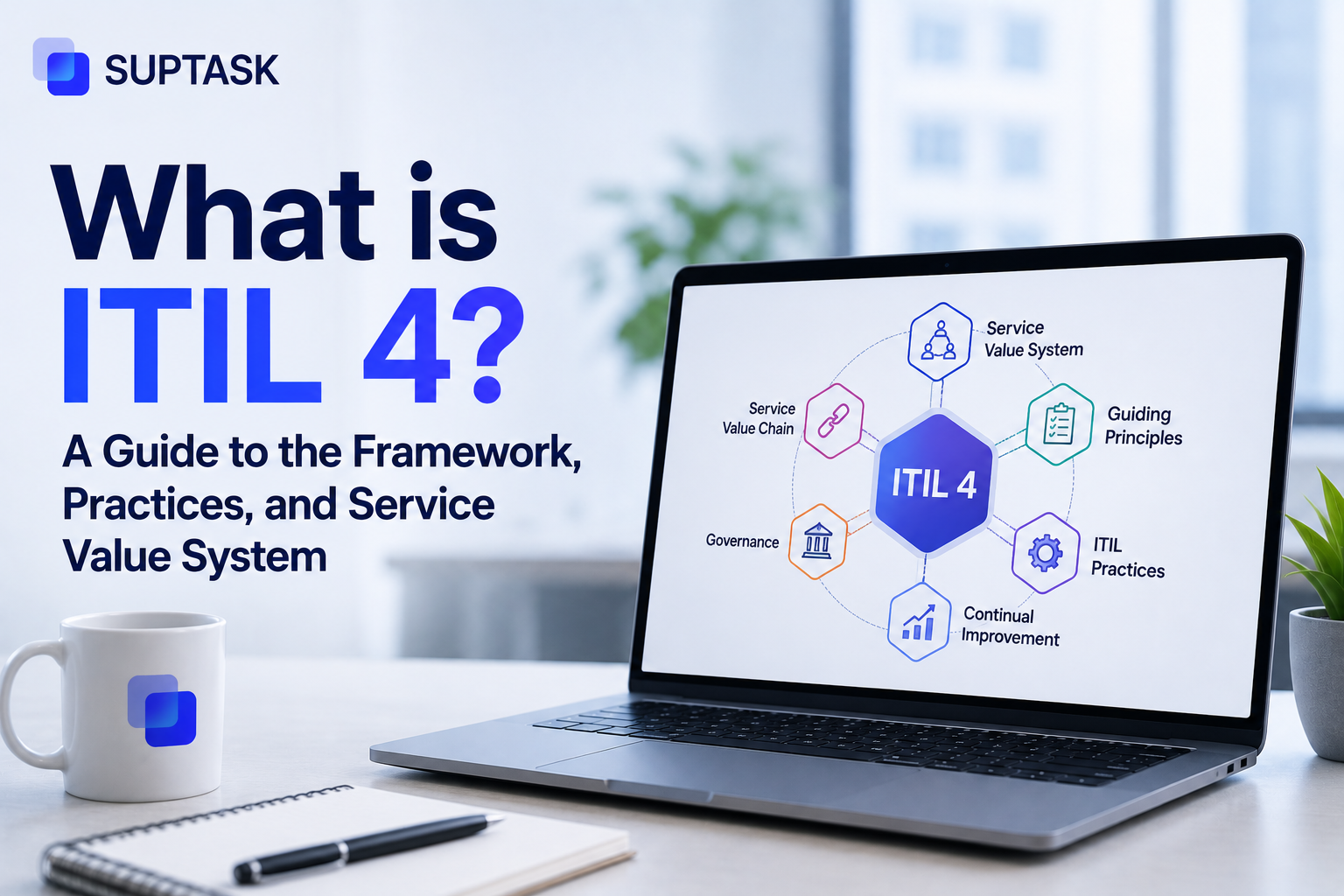
ITIL 4 is the current version of ITIL, which was released in 2019. It is the framework used by IT teams to manage and improve their services. It is based on the Service Value System, a model for how everything in service management fits together and turns demand into value.
If you have used ITIL v3, ITIL 4 will look similar to you in many ways. However, if you are completely new to this framework, then it is a must to know about its principles, dimensions, and 34 practices. This guide walks through what ITIL 4 actually is, the mental model behind it, the working parts, and, just as important, where to start with it without drowning in process.
What is ITIL 4?
ITIL 4 is a framework for IT teams to have a shared, structured way to run the IT services from planning and delivering to improving services. Simply put, it can be referred to as a common language or a set of proven practices that an IT organization can adapt to how it already works.
It is owned and maintained by PeopleCert, which publishes the official guidance and runs the certifications. ITIL goes back to the late 1980s and has been through several versions before ITIL 4.
ITIL 4 framework brings the IT and digital services together into what the business is trying to achieve, so technology work supports real outcomes. It was built using Agile and DevOps practices.
What changed from ITIL v3?
If you have worked following ITIL v3, ITIL 4 is more of an update rather than a new framework. However, there are some improvements introduced, as shown in the table.
ITIL increased core practices from 26 to 34, which is the biggest update. It brings the people, culture, tools, and information around the work, not just the steps.
The Service Value System
As said earlier, the Service Value System (SVS) is the brain of ITIL4 that replaced the traditional service lifecycle. The idea of SVS is to bring demand and opportunity where the work happens inside the SVS, and value comes out the other end.
The SVS has five components.
- Guiding principles: The core recommendations that guide decisions at every level, like focusing on value and keeping things simple.
- Governance: How the organization is directed and controlled. It sets the policies and boundaries within which the work runs and keeps service management pointed at the business goals. In a small team, it is informal, in a large one, it is a formal structure, but the job is the same.
- Service value chain: It is an operating model with a flexible set of activities that combine to create value.
- Practices: The 34 sets of capabilities for doing the actual work, from incident management to supplier management. These replaced v3's processes.
- Continual improvement: It is the ongoing efforts IT teams make to ensure services improve over time.
The seven guiding principles
The guiding principles are the practical advice that is driving everything in ITIL 4. Put simply, these seven guiding principles are meant to shape how you make decisions, whatever you are working on.
- Focus on value: Everything you do must be traced back to the value, either for the customer or the business. So, if an activity is not delivering value, it must be improved.
- Start where you are: Rather than building everything from scratch, you should retain what is working already, keep it, and improve it.
- Progress iteratively with feedback: Work in small steps rather than one big effort. Each step gives you feedback you can use to adjust the next one, instead of betting everything on a single rollout.
- Collaborate and promote visibility: Involve the right people and keep the work in the open. When decisions and progress are visible, trust goes up and surprises go down.
- Think and work holistically: No practice can work individually, thus, you should have an understanding of how different services work together.
- Keep it simple and practical: Use the fewest steps needed to get the outcome. If a process or control is not helping, remove it instead of adding more.
- Optimize and automate: Make the work as efficient as it can be first, then automate what makes sense. Automating a bad process just makes the mess faster.
These seven are designed to be used together, not picked à la carte. Also, you should not get to choose one or two while ignoring the rest. They affect each other, and applying them as a set is what keeps ITIL 4 flexible instead of rigid.
The four dimensions of service management
ITIL 4 says you have to look at any service from four angles, not just one. If you miss a dimension, it will lead to blind spots, like a great tool that nobody is trained to use. The four are:
- Organizations and people: The structure, roles, culture, and skills behind a service. A service is only as good as the people running it and the way they are organized to do it.
- Information and technology: The information a service uses and the technology that supports it, from the tools and systems to the data flowing through them. For most IT teams, the main tool here is an ITSM ticketing system, which logs every request, routes it to the right person, and keeps the record that practices like incident and change management depend on.
- Partners and suppliers: It refers to the external parties a service depends on. Along with external vendors, it also covers internal providers like another team in the same company.
- Value streams and processes: How the work actually flows to deliver value, the sequence of activities and steps that turn demand into an outcome.
These four apply to every service, all at once. The point is to weigh all four when you design or change something, because focusing on one and ignoring the rest is how services end up unbalanced.
The service value chain
The service value chain is the operating model at the center of the SVS. It is made up of six activities, and the work of delivering any service moves through some combination of them. The six are:
- Plan: Setting the direction and a shared understanding of where services are headed.
- Improve: Making services and practices better on an ongoing basis.
- Engage: Dealing with stakeholders, understanding what they need, and keeping them informed.
- Design and transition: Designing services and getting them into live use without breaking things.
- Obtain/build: Getting hold of or building the components a service needs.
- Deliver and support: Running the service day to day and supporting users.
These six are not sequential, so they can be executed in any order. You should think of them as activities that combine in different ways, called value streams, depending on the work.
For example, a simple incident might run through just Engage and Deliver and support, while a brand-new service might need all six.
The 34 ITIL practices
ITIL 4 calls them practices, not processes, and the difference is more than wording. A process is a set of steps. A practice is broader, as it includes the people and culture, the technology and tools, and the information and data needed to do the work well, not just the steps. ITIL 4 groups its 34 practices into three sets.
14 general management practices
These come from general business management and apply across the organization, not only IT.
- Architecture management: Keeping a clear view of how all the parts of the organization fit together.
- Continual improvement: The ongoing work of making services and practices better.
- Information security management: Protecting information and managing security risk.
- Knowledge management: Capturing and sharing knowledge so it is not locked in people's heads.
- Measurement and reporting: Tracking performance and reporting on it to support decisions.
- Organizational change management: Helping people through change so it actually sticks.
- Portfolio management: Deciding which services and projects to invest in.
- Project management: Delivering projects on time and within scope.
- Relationship management: Managing relationships with stakeholders and customers.
- Risk management: Identifying and handling risk across services.
- Service financial management: Managing budgets, costs, and the value of IT spend.
- Strategy management: Setting and steering the overall direction.
- Supplier management: Managing third-party suppliers and their contracts.
- Workforce and talent management: Making sure you have the right people and skills.
17 service management practices
These are the core of day-to-day IT service management.
- Availability management: Making sure services are available when users need them.
- Business analysis: Understanding needs and recommending solutions.
- Capacity and performance management: Making sure services have the capacity to perform.
- Change enablement: Assessing and approving changes so they cause as little disruption as possible.
- Incident management: Restoring normal service as quickly as possible after something breaks.
- IT asset management: Tracking and managing IT assets across their life.
- Monitoring and event management: Watching services and responding to events.
- Problem management: Finding and removing the root causes behind recurring incidents.
- Release management: Making new and changed services available for use.
- Service catalogue management: Maintaining a clear list of the services on offer.
- Service configuration management: Keeping accurate information about service components and how they connect.
- Service continuity management: Keeping services running, or recovering them, during a major disruption.
- Service design: Designing services that are fit for purpose and use.
- Service desk: The single point of contact between users and IT.
- Service level management: Setting and tracking service-level targets.
- Service request management: Handling routine user requests, like access or equipment.
- Service validation and testing: Checking that services work as intended before they go live.
3 technical management practices
These come from the technology side and have been adapted for service management.
- Deployment management: Moving new or changed components into live environments.
- Infrastructure and platform management: Managing the infrastructure and platforms services run on.
- Software development and management: Building and maintaining the software behind services.
Where to start with ITIL 4?
The ITIL 34 often leads people to believe that it will require a lot to implement all of them. However, you are not meant to implement all of them, you should implement something that might deliver value to you. Also, this is the fastest way to stall. The best practice is to start where you are and adopt the practices that can fix the current challenges.
For most teams, that means three or four practices, not thirty-four. In practice, the usual starting set is:
- Incident management, so outages and broken things get handled quickly and consistently.
- Service request management, so routine requests like access and equipment have a clear path.
- Change enablement, so changes get made with less risk and fewer surprises.
- Problem management, so the same incidents stop coming back.
The above-mentioned four practices often support all the day-to-day issues IT teams face, which is why they are considered to be the best starting point. So, you should start with a few and add more as you grow.
ITIL 4 with Agile, DevOps, and chat-first IT work
One of the main reasons ITIL 4 exists is to work with the modern ways IT teams already operate, instead of fighting them.
With Agile and DevOps
ITIL 4 has been introduced to work with Agile and DevOps. Following DevOps, it helps IT teams to map almost directly onto the "obtain/build" and "deliver and support" activities of the value chain. Also, you can build a change, run it, and support it in production.
So you are not choosing between ITIL and these ways of working. ITIL 4 is built to hold them together.
With chat-first IT work
ITIL 4 principles can also be applied to chat tools like Slack, where most of the teams work today.
Two principles are often most commonly used, including "Collaborate and promote visibility," which fits the moment your conversations and decisions happen in open channels, instead of sitting hidden in private ticket queues nobody else can see.
The second one is "Optimize and automate," which works when the ticket is created, routed, and updated right there in the chat tool, with no portal to switch to.
This is the gap Slack-native tools fill. Suptask is one of them, bringing ticketing into Slack so the work and the record stay in one place.
A brief note on ITIL 4 certification
ITIL 4 comes with a certification path, and it is worth knowing the shape of it even if you are not chasing a certificate.
Foundation is the entry-level certification, and it is where almost everyone starts. It covers the concepts in this guide: the SVS, the principles, the dimensions, and the practices. Above Foundation sit the more advanced levels: Practice Manager, Managing Professional, and Strategic Leader, and at the top, ITIL Master. Each one goes deeper and is aimed at more senior or specialized roles.
PeopleCert administers all of them. Costs vary a lot by region and by the training you take alongside the exam, so there is no single number to quote.
Frequently asked questions
What does ITIL 4 stand for?
ITIL stands for Information Technology Infrastructure Library. The "4" is simply the version number, not part of the acronym. So ITIL 4 means the fourth major version of the IT Infrastructure Library, the framework for IT service management.
What is the ITIL 4 Foundation?
ITIL 4 Foundation is the entry-level certification. It covers the core concepts of the framework, the Service Value System, the guiding principles, the four dimensions, and the practices. It is where most people start, and it needs no prior ITIL qualification.
How much does it cost to get ITIL 4 certified?
There is no single price. The ITIL 4 Foundation exam usually costs a few hundred dollars, often around $300 to $400, and it varies by region and by whether you take a training course alongside it. The higher-level certifications cost more.
Is ITIL 4 hard to pass?
Foundation is generally considered approachable. It is a multiple-choice exam testing your understanding of the concepts, not deep technical skill, and most people pass with some focused study. The higher levels are harder and aimed at more experienced professionals.
Is there an ITIL 5?
Yes. PeopleCert released ITIL Foundation Version 5 in February 2026, with further modules rolling out through the year. It builds on ITIL 4 and leans into AI-native service environments and digital product management. ITIL 4 is still the most widely adopted version for now.
How is ITIL 4 different from ITIL v3?
ITIL 4 replaced v3's processes with 34 practices, swapped the five-stage service lifecycle for the Service Value System, moved the guiding principles to the front, and was redesigned to work alongside Agile, DevOps, and Lean. The core ideas carried over, but the structure changed.
Final Take
ITIL 4 looks like a lot at first, but the heart of it is simple: a flexible system for turning demand into value, guided by a handful of sensible principles. You do not have to adopt all 34 practices to get something from it. Start with the few that fix your biggest problems, keep the process light, and let it grow from there.