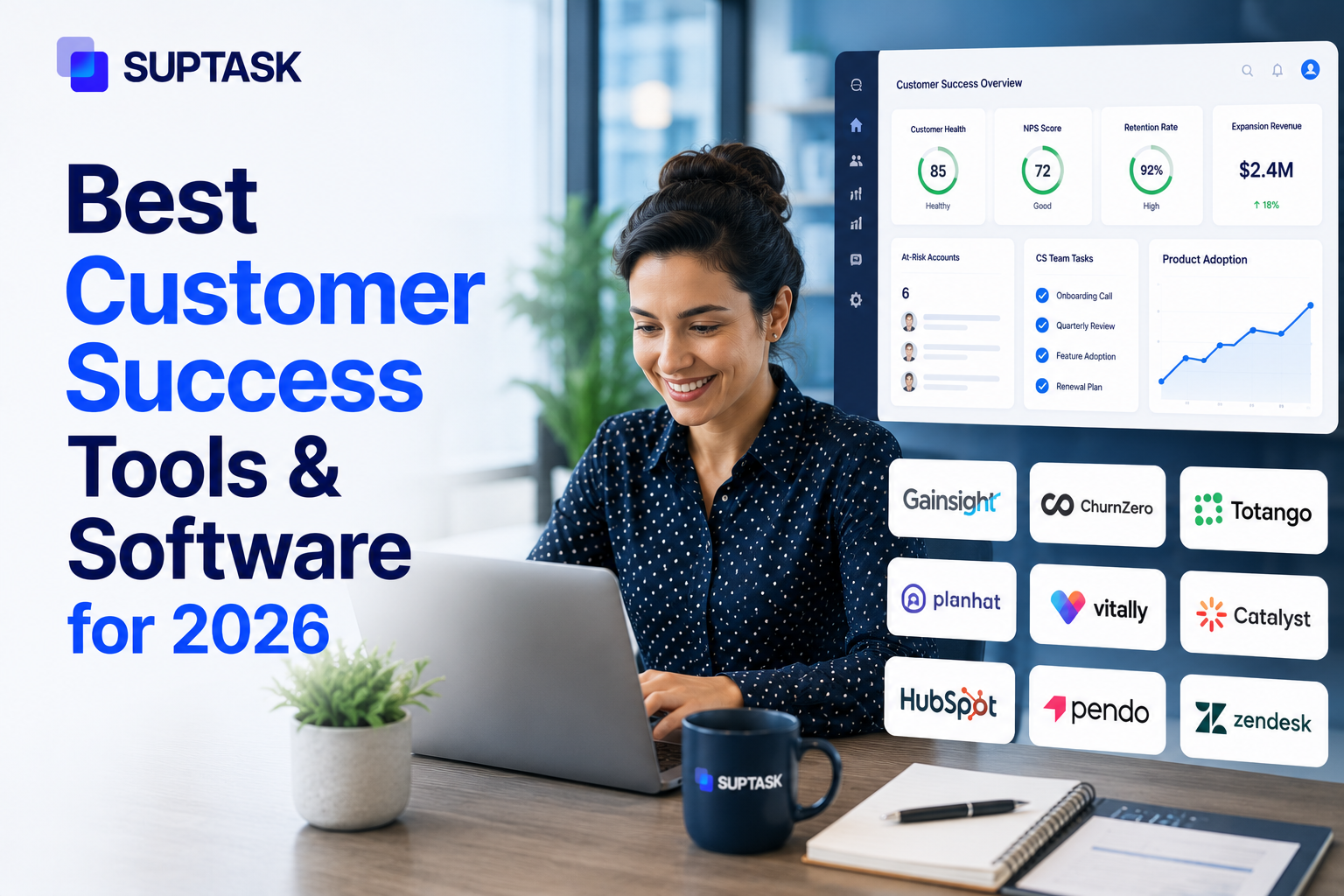
Customer success tools are the software that helps SaaS teams track customer health, drive product adoption, cut churn, and spot the accounts ready to expand.
The category includes dedicated CS platforms to product analytics, in-product engagement, customer feedback, and the AI features now spreading across all of them. No single tool does the whole job, so most teams run a stack of three to five that feed into each other.
This post covers what these tools are, when you actually need them, how to weigh them, and the core CS platforms by use case. Then it gets into the adjacent tools, the analytics, the engagement, the AI, and the feedback. If you are at an early stage, you may not need any of this yet, and the post covers that case too.
What are Customer Success Tools?
So what counts as a customer success tool? It is not one piece of customer success software, it is a few adjacent categories that each handle a part of the CS job.
- Core customer success platforms are the center of it, the Gainsight, ChurnZero, Vitally, and Planhat kind. They handle the health scoring, the renewal forecasting, the account management, and the day-to-day CS workflow.
- Product analytics tools like Pendo, Amplitude, and Mixpanel bring the usage data. CS teams read that data to catch the risk signals and see which accounts are actually engaged.
- Then come the in-product engagement tools, Userpilot, Appcues, and WalkMe. These run the onboarding, the feature announcements, and the nudges inside the product itself.
- For the softer signal, there are the feedback tools, Retently, AskNicely, and Refiner, which collect the NPS, the CSAT, and the things you only find out by asking.
- AI is the newest piece. Some of it is standalone tools, but mostly it is AI features getting built into the four categories above.
The lines between them are blurring fast, though. The CS platforms now bundle in product analytics, the analytics tools are adding in-product engagement, and AI is becoming a layer across all of it.
When does a SaaS company need dedicated customer success tools?
Here is the part most of these lists skip. You do not need dedicated customer success software on day one. Three signs tell you it is actually time.
- The customer count gets past what you can track. Somewhere around 100 to 200 paying customers, the spreadsheet stops keeping up. The health scores get unreliable, renewals slip through, and the CSMs end up spending more time on the reporting than on the customers.
- Renewal forecasting turns business-critical. Once the board is asking for NRR and GRR numbers and the team cannot give them anything defensible, dedicated tools pay for themselves quickly.
- The CS team gets big enough to need shared tooling. Around four or five CSMs, they need one source of truth they all work off, not five different spreadsheets.
Below those lines, a well-set-up CRM, Salesforce or HubSpot, plus a couple of spreadsheets usually covers the CS work fine. The tooling is not the hard part yet, the customer success strategies for SaaS are. Spending five figures a year on SaaS customer success software before you actually need it is one of the more common SaaS budget mistakes there is.
How to Choose Customer Success Tools?
Once you know you need something, here is how to weigh the options for a customer success management tool. Seven things actually matter, the rest is noise.
- Start with the problem, not the tool. Health scoring, renewal forecasting, product adoption, feedback, in-product onboarding- each one points at a different category, so work out which you have before you look at any vendor.
- A tool is only as good as the data going into it. Check the pre-built integrations with your CRM, Salesforce or HubSpot, plus product analytics, the support system and billing. That matters more than the feature list.
- Can you write your own health-score formula, or are you stuck with the vendor's model? You want the flexibility, because the thing that predicts churn in your business is usually specific to your business.
- Then the automation. What playbooks, triggers, and automated outreach can it actually run? A mature program needs deep customer success automation tools, a small team can start simple and add the rest later.
- Reporting is the one executives care about. Can it produce the NRR, the GRR, the churn cohorts, and the expansion pipeline they keep asking for? The customer engagement metrics it tracks should line up with the numbers your leadership already reports on.
- How long it takes to live. Enterprise platforms like Gainsight can run three to six months. Mid-market ones like ChurnZero or Vitally are more like four to ten weeks. Lightweight tools and product analytics can be up in days.
- Last, pricing. Most CS platforms do not publish it, they negotiate, while the analytics tools like Pendo, Amplitude, and Mixpanel often show tiers. Get real numbers from peers who bought recently, not from the sales deck.
No tool wins on all seven. Rank the ones that matter most for where you are, and choose against those.
The Best Customer Success Platforms By Use Case
These are the dedicated CS platforms, the core layer of the stack. They are grouped here by who they fit, because the platform that suits a 500-person enterprise rarely suits a team of eight.
Best For Enterprise Customer Success Programs
Gainsight
Gainsight is the category leader, the platform most people picture when they hear customer success software. It covers a lot, health scoring, journey orchestration, renewal forecasting, CS operations, product adoption, even customer education.
- Best for: Enterprise CS programs with dedicated CS Ops, multi-product SaaS, and large named-account portfolios.
- Less useful for: Early-stage or mid-market teams with no CS Ops to run it, where most of the platform goes unused.
- Pricing: Not published. Enterprise contracts reportedly start in the mid-five figures a year and climb from there.
- Implementation: Usually three to six months for a rollout that actually does something.
Totango
Totango merged with Catalyst back in 2024, and the combined product runs under the Totango name now. Its strength is customer journey orchestration across a big, segmented base.
- Best for: B2B SaaS with structured, multi-segment portfolios that need journey orchestration at scale.
- Less useful for: Lighter use cases where the full platform is more than the team will ever touch.
- Pricing: Not published.
- Implementation: Reportedly six to twelve weeks.
Best For Mid-Market Saas Customer Success
ChurnZero
Built for the mid-market, ChurnZero leans on health scoring, automated playbooks, and churn prediction. It has been adding AI features steadily through 2025 and 2026.
- Best for: Mid-market B2B SaaS teams, roughly 10 to 50 CSMs, focused on retention and expansion.
- Less useful for: Very large enterprise programs, or very small teams that will not use the automation.
- Pricing: Not published.
- Implementation: Usually six to ten weeks.
Vitally
Vitally leans visual, workflow-driven, with a modern interface. Teams that want a CS platform that feels designed tend to land here.
- Best for: Mid-market SaaS that value visual workflows and a clean UI.
- Less useful for: Very large programs that need deeper customization than the visual model allows.
- Pricing: Not published, though it usually comes in under Gainsight at a comparable team size.
- Implementation: Typically four to eight weeks.
Planhat
Planhat comes out of Europe, and its pull is account-level analytics with a modular setup you can shape around your own data.
- Best for: Data-led CS teams that want control over how the data flows in.
- Less useful for: Teams that would rather have prescriptive playbooks working out of the box.
- Pricing: Not published.
- Implementation: Around six to ten weeks.
Best For Early-Stage Saas And Smb
Custify
For SMB SaaS, Custify is the lightweight option, quicker to set up and cheaper to run than the enterprise names.
- Best for: SaaS companies under about 200 customers standing up their first CS function.
- Less useful for: Enterprise programs that need deep customization.
- Pricing: Sold by quote rather than public tiers, reportedly starting around $899 a month for a few seats (verify current).
- Implementation: Usually two to four weeks.
ClientSuccess
ClientSuccess covers the CS basics without the enterprise weight, and it is strong on the relationship side, renewals, and the account check-ins.
- Best for: Small to mid B2B SaaS teams focused on renewal and expansion fundamentals.
- Less useful for: Teams that need heavy automation or tight product-analytics integration.
- Pricing: Not published.
- Implementation: About three to six weeks.
SmartKarrot
SmartKarrot brings playbook automation in a configurable setup, priced in the mid-market tier.
- Best for: Growing teams that want playbook automation without an enterprise commitment.
- Less useful for: Very small teams that do not need playbook depth yet.
- Pricing: Quote-based, reportedly from around $15,000 a year (verify current).
- Implementation: Roughly four to eight weeks.
Best If You Already Use HubSpot
HubSpot Service Hub
HubSpot Service Hub is not a dedicated CS platform, it is the service module bolted onto HubSpot's CRM. For teams already on HubSpot, it is a credible way to run CS workflows without buying something separate.
- Best for: SaaS companies already on HubSpot CRM that want CS workflows in the same place.
- Less useful for: Enterprise programs that need deeper, CS-specific functionality.
- Pricing: Published. Service Hub Professional is $90 per seat a month on annual billing, plus a one-time onboarding fee (HubSpot pricing, as of July 2026).
- Implementation: Days to a few weeks, depending on how much HubSpot is already set up.
Best Adjacent Customer Success Tools
Real CS teams do not run just a CS platform. The categories below are the adjacent tools that fill out a modern stack: product analytics, in-product engagement, customer feedback, and AI.
Best Customer Analytics and Insights Tools
Which customer insights tool is most effective depends on the depth you actually need.
Pendo
Pendo rolls product analytics, in-product engagement, and customer feedback into one platform, which makes it a strong all-in-one for teams that do not want three separate tools.
- Best for: PLG companies that want analytics, engagement, and feedback in one place.
- Less useful for: Account-led B2B where most of the CS work happens outside the product.
- Pricing: Not published.
Amplitude
Amplitude is deep product analytics, strong on cohort analysis and behavioral signals. CS teams use it to spot product friction and read the adoption patterns.
- Best for: Data-heavy CS teams that need deep behavioral analysis.
- Less useful for: Lightweight CS workflows where Pendo or Mixpanel are simpler.
- Pricing: Published tiers, including a free tier.
Mixpanel
Mixpanel is event-based analytics, and it usually gets paired with a separate CS platform rather than replacing one.
- Best for: PLG SaaS where event tracking is core to understanding customer behavior.
- Less useful for: Subscription businesses where account-level analysis matters more than the event level.
- Pricing: Published tiers, including a free tier.
Heap
Heap does auto-capture, it records what users do without anyone hand-instrumenting the events first. That is the pull, you get the data without the engineering time.
- Best for: Teams that want to analyze customer behavior without the engineering investment in event tracking.
- Less useful for: Teams that need a precise, intentional event taxonomy.
- Pricing: Not published for the paid tiers, has a limited free tier.
Best In-Product Engagement And Onboarding Tools
These are the onboarding and engagement tools that pair with customer success, the ones that run adoption inside the product.
Userpilot
Userpilot handles in-product onboarding flows, feature announcements, and engagement, and it is strong for PLG companies.
- Best for: PLG SaaS focused on in-product onboarding and feature adoption.
- Less useful for: High-touch enterprise CS where the engagement happens outside the product.
- Pricing: Published tiers.
Appcues
Appcues is one of the established names here, strong on no-code flows that product teams can build without engineering.
- Best for: Product-led companies that want onboarding and engagement without writing code.
- Less useful for: Teams already deep in a CS platform that includes engagement features.
- Pricing: Published tiers.
WalkMe
WalkMe is the enterprise digital adoption platform, heavier than Userpilot or Appcues but more capable once the workflows get complex.
- Best for: Enterprise digital adoption programs with complex software-training needs.
- Less useful for: Lightweight SaaS onboarding where Userpilot or Appcues fit better.
- Pricing: Not published.
Chameleon
Chameleon is a mid-market in-product engagement tool, with a modern, designer-friendly UI.
- Best for: Mid-market PLG SaaS with design-quality expectations.
- Less useful for: Very large enterprise programs.
- Pricing: Not published.
Best AI Tools For Customer Success In 2026
AI in CS moved from buzzword to actual capability across 2025 and 2026. The list below is about specific features, not "AI-powered" claims on a landing page. The best AI tools for customer success right now deliver churn prediction, sentiment analysis, AI-suggested next-best-actions, and AI-drafted customer outreach, and most of them are features inside a platform you may already run.
Gainsight AI
Gainsight AI, branded Sally, is the AI layer inside Gainsight, conversational AI for CSMs, churn-risk prediction, and AI-drafted customer communication.
- Best for: Existing Gainsight customers extending into AI features.
- Less useful for: Standalone AI evaluation outside an existing CS platform.
ChurnZero ZOE
ZOE is ChurnZero's built-in AI assistant, focused on surfacing customer signal and recommending the next CSM action.
- Best for: ChurnZero customers extending into AI workflows.
- Less useful for: Standalone AI use without the ChurnZero platform.
Catalyst Copilot
Catalyst Copilot, now part of Totango, layers AI into the Totango and Catalyst platform for customer health and action recommendations.
- Best for: Totango customers wanting deeper AI capability.
- Less useful for: Standalone use.
Vitally AI
Vitally has added AI for note summarization, pulling action items out of customer calls, and general CSM productivity.
- Best for: Existing Vitally customers.
- Less useful for: Teams not already using Vitally.
A few standalone capabilities are worth a look too. AI call-analysis tools like Gong and Chorus pull customer signal out of sales and CS calls, sentiment tools read support and CSM messages for risk, and AI-drafting tools write a first-draft customer email off the account context.
Here is the honest part. Most "AI for CS" right now is AI features added onto existing platforms, not standalone AI-first tools. The market has not produced a credible AI-first CS platform that pushes the established players out yet. That could change in 2027, so it is worth watching.
Best Customer Feedback and Survey Tools For Cs
Retently
Retently is a survey platform for NPS, CSAT and CES that sends surveys by email, SMS and in-app, and posts new responses to Slack or Microsoft Teams.
- Best for: SaaS teams that want satisfaction surveys running on a schedule, with responses tagged by topic and sent to the CSM channel in Slack.
- Less useful for: Long multi-question research surveys, where Qualtrics or SurveyMonkey fit better.
- Pricing: Published tiers, with a 14-day free trial and no credit card required.
AskNicely
AskNicely is a feedback platform built around NPS, with the results feeding into CSM workflows.
- Best for: B2B SaaS where NPS feeds straight into CSM action.
- Less useful for: Teams that need broader survey capabilities beyond NPS.
- Pricing: Not published.
Refiner
Refiner runs in-app micro-surveys, built for SaaS teams collecting contextual feedback inside the product itself.
- Best for: PLG SaaS that wants lightweight in-product feedback.
- Less useful for: Teams needing broader survey capabilities outside the product.
- Pricing: Published tiers, including a free tier.
Whichever you pick, the signal only helps if it reaches the CSM in time, which is really a question of how to track customer feedback and route it, not which survey tool you buy.
Free and Budget Customer Success Options
Most of the established CS platforms do not have a real free tier, so the search for the best free customer success software usually ends in a mix of the things below. None of them is a dedicated platform, but together they cover the "we can't afford one yet" case.
- HubSpot's free CRM tier does more than people expect. Pair it with custom properties and a few workflows, and it runs the basic CS work, at least until you are past 50 customers or so.
- Then there is the spreadsheet, plus calendar reminders. A well-kept sheet with health-score columns, owner assignments, and scheduled check-ins carries a lot of early-stage teams further than they admit. The first 50 to 100 customers are the spreadsheet phase for most companies, and that is fine.
- Notion or Airtable templates give you a bit more structure than a raw spreadsheet, without much cost.
- For the product side, Mixpanel and Amplitude both have free tiers that do real product analytics for a small team.
- Refiner has a free tier as well, limited, but workable for collecting in-product feedback early on.
None of this is a dedicated platform. It is the stack you run before you need one, and there is no shame in staying here a while.
Where Does Suptask Fit In a Customer Success Stack?
Suptask is a Slack-native ticketing tool, built for customer support that runs inside Slack, and in a customer success stack it works as the support layer alongside your CS platform.
Here is where it fits. Plenty of B2B SaaS teams now run support through Slack Connect, each customer in their own shared channel. Suptask turns the requests in those channels into trackable tickets, one click from any message, with no separate portal or extra login for the customer. Your CS platform tracks the health score, and Suptask tracks the tickets behind the support signal that feeds it.
So the pairings are simple. ChurnZero or Vitally for the core CS work, plus Suptask for the Slack-based support. Or HubSpot Service Hub with Suptask as the Slack ticketing layer. If your support already lives in Slack, the Slack integration is where it starts.
Common Mistakes When Choosing Customer Success Tools
The failure modes here are pretty consistent. Five of them come up again and again, and they are all avoidable.
- Buy the platform before you have defined the workflow, and you get an expensive empty box. Teams that get Gainsight with no documented health-score formula and no renewal playbook end up with a tool nobody uses.
- The enterprise platform below enterprise scale is a classic. Match the complexity to whether you can actually operate it. An 8-CSM team with no CS Ops has no business running Gainsight.
- The sticker price is a small number. The real cost is the implementation, the data integration, the workflow design, the training, the ongoing admin, and in year one that often runs past the license fee.
- Then there is tool sprawl, a CS platform plus three analytics tools plus two engagement tools, none of them talking to each other. You end up with fragmented data nobody can use. Define the stack first, then buy the tools.
- Chasing AI features you have not verified. "AI-powered" is on nearly every CS tool's site in 2026. Demo the actual thing against your own data before you believe any of it.
Every one of these costs more than the license does. Slow down before the purchase, not after.
Frequently Asked Questions
How much should we budget for customer success tools?
It depends on scale, but a typical SaaS CS stack runs somewhere from $20K to $100K or more a year in software. The enterprise platforms alone start in the mid-five figures and climb from there. Mid-market platforms come in lower, low to mid five figures, and the adjacent tools, the analytics, the engagement, the feedback, add maybe another $10K to $30K on top. A small team can put a working stack together for $5K to $15K.
What's the difference between a CS platform and a product analytics tool?
They own different layers. A CS platform like Gainsight or ChurnZero owns the relationship layer, the health scoring, the renewal forecasting, the CSM workflow. Product analytics tools like Pendo, Amplitude, and Mixpanel own the behavior layer, what users actually do inside the product. Most stacks run both, with the CS platform pulling the analytics data in to shape its health scores.
Can you run customer success in Salesforce or HubSpot without a dedicated CS platform?
Yes, especially under 200 customers. Salesforce with custom objects for health scoring handles a fair bit of the CS workflow, and HubSpot Service Hub is getting more viable for it. The trade-off is reporting depth and automation, the dedicated CS platforms still do more once you scale.
Do you need separate tools for product analytics and customer success?
Often, yes. The two serve different layers, one the relationship and one the behavior. A few all-in-one tools like Pendo or Userpilot try to bridge them, and they work for PLG companies, but they usually cannot replace a dedicated CS platform for account-led B2B.
How long does it take to implement a customer success tool stack?
It depends on the tool. The lightweight ones, Custify, Refiner, Mixpanel's free tier, are live in days to a couple of weeks. Mid-market platforms like ChurnZero or Vitally take four to ten weeks, and the enterprise ones like Gainsight or Totango run three to six months. A full stack, the platform plus analytics plus engagement, usually takes four to six months to actually operationalize.
Are "AI-native" customer success tools worth evaluating in 2026?
Most "AI-native" branding right now is really AI features bolted onto a traditional CS platform. A genuinely AI-first tool has not displaced the established players yet. Demo the specific capability against your own data before you buy the story, because a lot of AI features look great in a scripted demo and fall short on real customer data.
Should small SaaS startups invest in any of these tools?
Usually not yet. Under 100 customers, the right answer is normally HubSpot's free CRM, or whatever CRM you already have, plus structured spreadsheets and calendar reminders. Add free-tier product analytics from Mixpanel or Amplitude once the behavioral signal is worth reading. Dedicated CS platforms make sense once the customer count and the team size justify the spend.