
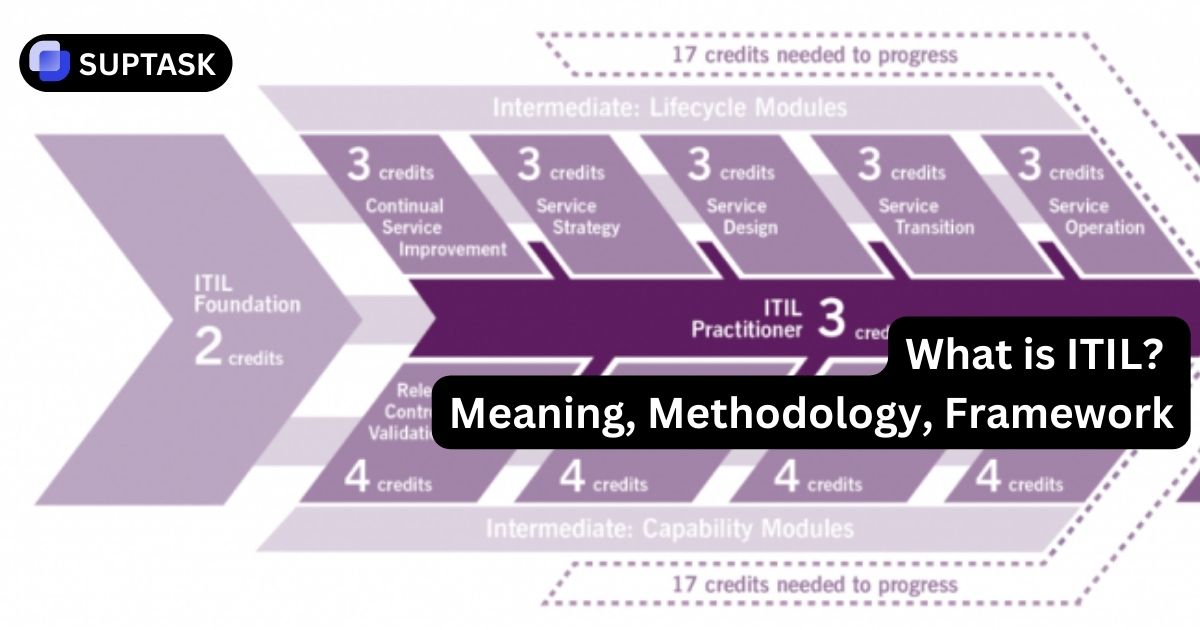
ITIL is a best practice framework used to manage and improve IT services so they consistently create value for the business and the people who rely on those services. It is most often used within IT Service Management (ITSM), especially in environments that run a service desk or help desk.
Key takeaways
A fast summary of what ITIL is and how to talk about it accurately.
- 1 ITIL is a framework of best practices for managing services. It is not a product, not a tool, and not a compliance standard.
- 2 ITIL supports ITSM by giving shared language and repeatable ways of working across incidents, requests, changes, and continual improvement.
- 3 ITIL 4 introduced the Service Value System and Service Value Chain, plus a practices model instead of only process diagrams.
- 4 ITIL (Version 5) builds on ITIL 4 and adds a unified product and service lifecycle model, with stronger emphasis on AI governance and complex environments.
What is ITIL
ITIL explains how to run services end to end, from defining value to improving day-to-day delivery.
At its simplest, ITIL is a set of best practices for managing IT enabled services. It focuses on what good service looks like, how work flows across teams, and how to keep improving without creating unnecessary bureaucracy.
In real organizations, ITIL usually shows up in incident management, service request handling, change control, service level management, and knowledge management. Those building blocks are why ITIL is closely associated with service desks and support operations.
What ITIL is not
ITIL does not prescribe one mandatory workflow for every organization. It is designed to be adapted to your environment, your constraints, and your tooling.
ITIL meaning and what ITIL stands for
The acronym matters mostly for context. In practice, ITIL is used as a proper name.
ITIL originally stood for Information Technology Infrastructure Library. The name comes from its early history as a library of guidance that was published and expanded over time. Today, most teams simply say ITIL, referring to the framework and the official guidance and certifications that surround it.
If you are comparing approaches, ITIL is one of several ITSM frameworks, alongside options like COBIT and standards like ISO 20000 compliance.
Is ITIL a methodology
Many people call ITIL a methodology. A clearer way to say it is that ITIL provides methods and models inside a framework.
A methodology usually implies a defined method you follow in a specific order. ITIL is different: it is a framework that offers principles, practices, and models you can combine into value streams that fit how your organization actually works.
That is why two organizations can both use ITIL and still have different workflows. The goal is not identical process maps. The goal is consistent value delivery, predictable outcomes, and a culture of continual improvement.
ITIL framework essentials
ITIL has evolved over time. The key is understanding the current model and the language teams use today.
ITIL 4 in plain English
ITIL 4 (introduced in 2019) is organized around the Service Value System, including a Service Value Chain (Plan, Improve, Engage, Design and transition, Obtain/build, Deliver and support) and a set of 34 management practices.
ITIL (Version 5) and what changed
ITIL (Version 5) builds on ITIL 4 and adds an eight-stage product and service lifecycle model (Discover, Design, Acquire, Build, Transition, Operate, Deliver, Support) with an AI-native and complexity-native focus. Official details are published on ITIL.com.
| Topic | ITIL 4 | ITIL (Version 5) |
|---|---|---|
| High-level model | Service Value System with a Service Value Chain. | Builds on the Service Value System and introduces a product and service lifecycle model. |
| Value flow | Six value chain activities that can be combined into value streams. | Eight lifecycle activities that explicitly span discovery through support. |
| Practical emphasis | Practice driven guidance plus seven guiding principles. | AI-native, complexity-native, and designed to be more relatable at Foundation level. |
| Who it serves | Service management in modern digital environments. | Digital product and service management with stronger AI governance context. |
Older ITIL editions are often described through a five-stage service lifecycle model. That language still appears in many organizations, but modern ITIL is less about strict phases and more about flexible value streams.
ITIL vs ITSM
ITSM is the discipline. ITIL is one of the most widely used frameworks inside that discipline.
ITSM means the overall way an organization designs, delivers, manages, and improves IT services. ITIL provides shared language and proven practices to help teams do ITSM with less guesswork.
This is also why ITIL discussions quickly touch ITSM frameworks and related standards. For example, ISO 20000 compliance is a formal IT service management standard, while ITIL is best practice guidance you can adopt and tailor.
Why ITIL Matters for Modern Organizations
ITIL matters because most organizations do not fail due to lack of effort. They fail due to inconsistency, unclear ownership, and invisible work.
Without a shared service framework:
- Incidents are handled differently by each team
- Escalations depend on personalities instead of process
- Changes create risk because nobody sees the full system
- Metrics are reactive instead of predictive
ITIL introduces structure without forcing rigidity. It gives teams:
- A common language for incidents, requests, changes, and problems
- Defined practices instead of tribal knowledge
- Clear ownership and accountability
- A built-in model for continual improvement
In modern environments where automation, cloud services, and AI systems interact constantly, complexity compounds quickly. ITIL provides a way to coordinate that complexity without slowing teams down.
That balance is why ITIL remains relevant decades after its original publication.
Benefits and Limitations of ITIL
No framework is perfect. ITIL is powerful, but only when applied correctly.
Benefits of ITIL
- Improves service consistency across teams
- Reduces firefighting by clarifying incident and change ownership
- Aligns IT work with business outcomes
- Encourages continual improvement instead of reactive fixes
- Scales from small service desks to enterprise operations
When implemented thoughtfully, ITIL reduces chaos and increases predictability.
Limitations of ITIL
- Over-implementation can create bureaucracy
- Copy-paste adoption without context leads to resistance
- Certification does not equal operational maturity
- Framework guidance still requires leadership discipline
ITIL works best when used as guidance, not dogma.
It should support outcomes, not replace thinking.
Organizations that treat ITIL as a toolbox tend to succeed.
Organizations that treat it as a rulebook tend to struggle.
Where ITIL shows up in day-to-day work
ITIL is most visible where service work repeats: support, operations, and cross-team coordination.
The quickest place to see ITIL concepts in action is the service desk. Even a basic help desk naturally evolves toward ITIL practices once teams need clearer prioritization, consistent triage, and measurable outcomes.
ITIL also becomes more tangible when organizations invest in help desk automation and service desk automation. Automation makes workflows explicit, which forces teams to define what an incident is, what a service request is, how approvals work, and what the service levels should be.
A practical example
When an access request comes in, teams often route it through verification, approval, fulfillment, and audit logging. That is a service request flow. When an outage happens, teams prioritize restoration and communication first. That is incident management. The difference is detailed in service request vs incident.
Finally, ITIL drives measurement conversations. Service desks that adopt ITIL usually mature toward tracking volume, speed, quality, and experience metrics over time. One place to see common measurement patterns is help desk metrics.
FAQ
Common questions that come up when people search for what ITIL means.
Is ITIL only for large enterprises
No. ITIL scales down well when used as guidance, not bureaucracy. Small teams often adopt a few practices first, especially incident management and service request handling, and then expand only as needed.
Do you need ITIL software to use ITIL
No. ITIL is framework guidance. Tools can support the workflows, measurement, and governance, but ITIL itself is not tied to any single platform.
Is ITIL the same as a service desk
Not exactly. A service desk is a function or team. ITIL is a framework that often informs how a service desk operates, especially when moving from reactive ticketing toward business-aligned service management.
Turn ITIL ideas into consistent service delivery
ITIL becomes real when workflows are visible, owned, and measured. If your support work lives in chat, a ticketing system inside Slack can make service work easier to run and easier to improve.
Explore help desk automation