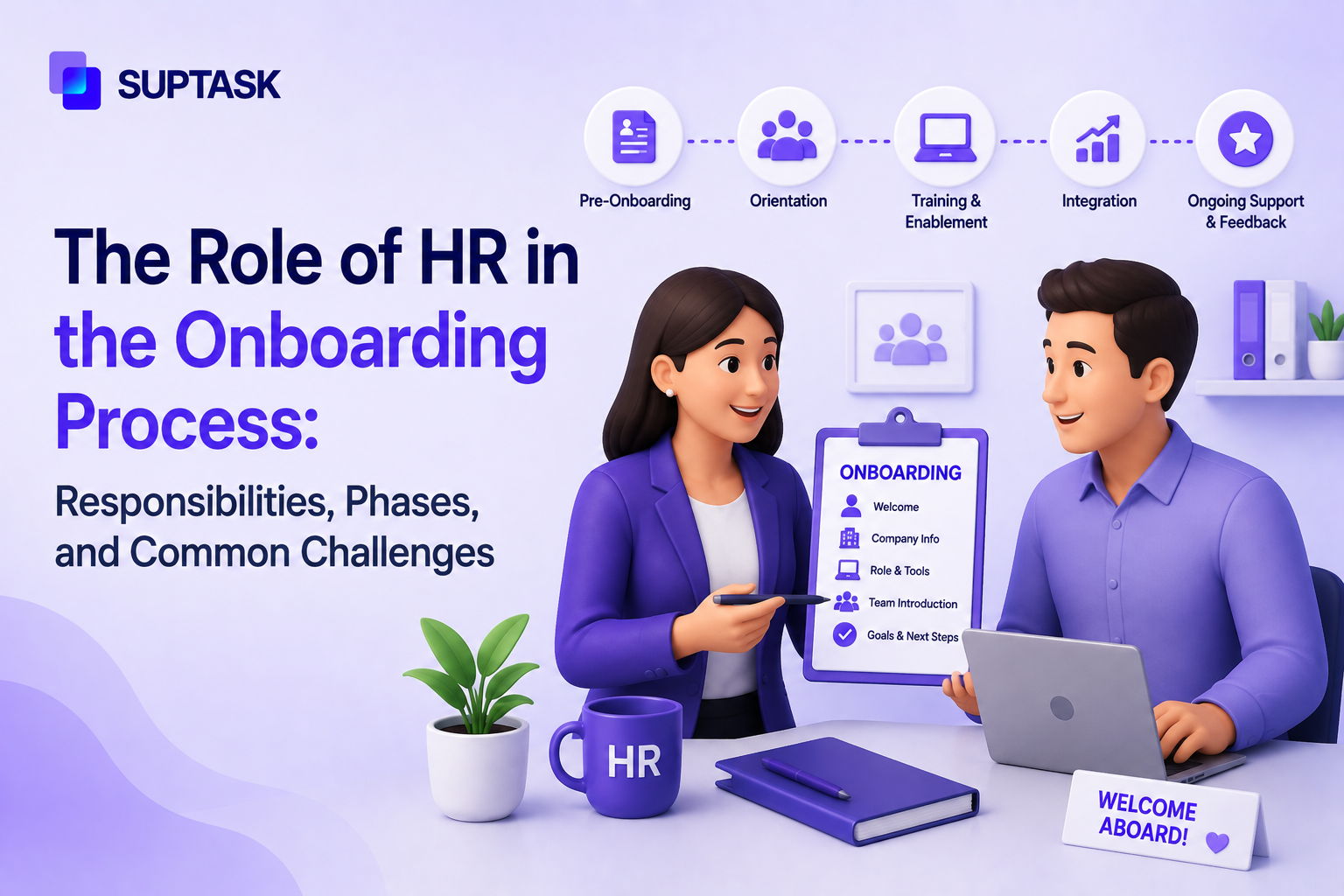
A new hire's first week decides whether they stay and how quickly they become productive. HR is at the center of that. The role of HR in the onboarding process runs beyond the paperwork and other formalities.
This guide will help you understand what HR actually does during onboarding. HR's core duties come first, then the split with the hiring manager. After that, the work in each phase. The last sections cover the common challenges and the metrics that show if onboarding worked.
What Is Employee Onboarding (and Why HR Owns It)?
Employee onboarding is the process of bringing a new hire into the company and making them productive. It begins when a candidate accepts the offer and runs through the first 90 days or longer.
People often think onboarding and orientation are the same, however, they are different. Orientation is a one-day process emphasizing essential forms, team introductions, and an office tour. Onboarding is a longer process that supports employees through their initial days at the company.
The role of HR in the onboarding process is one of ownership. HR designs the framework that every team follows and coordinates with other teams to help new hires with all their queries. HR also fields the many questions new hires have, the same way a help desk handles requests.
Onboarding is not HR's job alone, though. The hiring manager handles role-specific training and the daily work of settling someone into the team. HR sets up the structure, and the manager adds the context.
There is plenty of room to do this better. Only 12% of employees strongly agree that their company does a great job of onboarding, according to Gallup. The gap is a process problem, and solving it falls to HR.
HR's Core Responsibilities in the Onboarding Process
The role of HR in onboarding splits across a few core jobs like:
- Process design: HR designs and maintains the onboarding framework that brings consistency in onboarding for every new hire, irrespective of their departments.
- Compliance and paperwork: Whether it is contractual, part-time, or full-time hiring, HR manages the documentation process that includes, but is not limited to, background checks, policy sign-offs, and any NDA.
- Benefits enrollment: HR enrolls the new hires in the health plan, gratuity, and other benefits the company offers.
- Culture and values: Helping new hires to get familiar with the company's history, mission, and other essential information is a core responsibility.
- IT and equipment: HR triggers IT for the laptop, software, email, and Slack access. Facilities readies the desk and badge on HR's cue.
- Training: HR schedules the compliance training, the role training with the manager, and any tool training the job needs.
- Buddy or mentor: HR pairs the new hire with a peer for the social side that a checklist cannot cover.
- Check-ins and feedback: HR runs the check-ins at 30, 60, and 90 days, then uses the survey to fix gaps.
HR vs. Hiring Manager: Who Owns What?
HR and the hiring manager both have an integral role in the onboarding process. Simply put, HR owns the process, while the manager owns the role.
- HR owns: Process design, compliance, benefits, culture orientation, tooling, mentor assignment, onboarding metrics, and cross-functional coordination.
- The manager owns: Role-specific training, performance expectations, team introductions, daily mentoring, project assignments, first-month goals, and career conversations.
- Both share: Communication with the new hire, feedback collection, and escalating issues when they come up.
The best onboarding is the partnership between HR and the hiring manager. HR gives every manager the reason to stay with the company, while the manager trains them to do their best in their role.
The Onboarding Process Phase by Phase: HR's Role at Each Stage
HR's role shifts across the onboarding phases. Here is a detailed understanding of how the role varies phase by phase.
Pre-Boarding, Before Day One
- Send the welcome packet and collect paperwork online.
- Trigger IT to set up the laptop and accounts.
- Share the first-day logistics and assign a buddy.
- Set up the HRIS and payroll records.
- Send an invite to the #new-hire Slack channel.
Day One, Orientation
- Run the welcome orientation on history, values, and policies.
- Finish any remaining compliance documents.
- Cover the benefits and give an office or virtual tour.
- Introduce the new hire to the team.
- Hand off to the manager for role-specific onboarding.
Week One, Integration
- Check in every day or two.
- Confirm IT access is working.
- Make sure the training schedule has started.
- Set up the first 1:1 with the manager.
- Answer questions on benefits, policies, and tools.
Month One, Ramp-Up
- Hold the 30-day check-in.
- Review how much training is done.
- Gather early feedback and address concerns.
- Confirm the manager is holding regular 1:1s.
90 Days, The Review
- Hold the formal 90-day review.
- Measure performance against the first goals.
- Send the onboarding satisfaction survey.
- Note any gaps that are still open.
- Move the person from new hire to team member.
Ongoing, Retention
- Run quarterly pulse checks.
- Hold career development talks.
- Fold onboarding into performance management.
Common Onboarding Challenges (and How HR Can Solve Them)
No onboarding runs perfectly. The employee onboarding challenges below show up again and again, and HR has a way to handle each one.
Information Overload on Day One
The first day of each employee should feel light rather than overloading them with a lot of information. Forms, tools, names, and policies all come at once, so HR should be there to make their concerns heard, and there should be a knowledge base to find answers to their common questions.
Disconnected Systems and Manual Handoffs
The onboarding process runs through a few teams at once. From HR and IT to administrators, finance, and other teams have their specific role in onboarding. When there is no centralized view of the onboarding progress, things often get missed.
A central ticket queue keeps each task visible until it is finished. Some teams run this through Slack-native ticketing, where a new hire messages #hr-help and a ticket opens on its own.
Unclear Ownership Between HR and Managers
A lot of onboarding problems trace back to a simple mix-up: HR thinks the manager has something, the manager thinks HR does, and it falls to nobody. The way out is the split from the last section, put in writing and shared with both sides. Once each person can see what is theirs, the guesswork goes away.
Remote and Hybrid Onboarding Gaps
Remote hires miss the small in-person moments, the hallway chat, and the desk-side help. Culture is harder to pass on through a screen, and time zones slow every back-and-forth. HR makes up for it with a virtual buddy, a real async plan, and a short welcome video from someone in leadership.
Compliance Delays
Compliance is where onboarding quietly falls behind. A form goes unsigned, a background check stays in limbo, an acknowledgment never gets clicked. Moving the paperwork before day one solves most of it, so the new hire arrives already cleared.
Missing Feedback Loops
HR cannot improve what it never measures, and a lot of teams never actually ask the new hire how it went. A light survey at 30, 60, and 90 days closes that gap. A new-hire NPS and a short manager check-in note round it out, giving HR something to act on.
New Hires Afraid to Ask Questions
Plenty of new hires stay quiet because they do not want to look lost or bother anyone. The answer is a channel that feels safe and takes no effort to use. A #new-hires space in Slack, an anonymous option, and a well-stocked FAQ all lower that barrier.
How to Measure Onboarding Success
Numbers tell HR whether onboarding is working. A handful is enough, so here are the ones worth tracking.
- Time-to-productivity: How long a new hire takes to reach full output, where a shorter ramp means the process is doing its job.
- 90-day retention rate: The share of new hires still on the team at three months, which flags a rough start when it dips.
- New-hire NPS: A short survey score that shows how the hire rated the whole onboarding experience.
- Training completion rate: The percentage of required training finished on time.
- Manager satisfaction: How managers rate the onboarding support HR gave them, a view the new-hire surveys miss.
Frequently Asked Questions
What is the role of HR in onboarding?
HR designs, coordinates, and runs the onboarding process end to end. It covers compliance, benefits enrollment, culture orientation, training, and the ongoing check-ins. HR keeps the process consistent across the company and measures how well it works. The hiring manager handles role-specific training and daily integration.
Who is responsible for onboarding, HR or the manager?
Both. HR owns the process framework, which means compliance, benefits, culture, tooling, and metrics. The hiring manager owns role-specific training, performance expectations, and team integration. The best programs run it as a partnership, with HR giving the structure and the manager adding the context.
What is the difference between onboarding and orientation?
Orientation is a one-time event on day one, covering company history, policies, and logistics. Onboarding is the longer process around it, running 90 days and sometimes up to a year. It carries the new hire from paperwork all the way through performance development.
How long should the onboarding process be?
At least 90 days. The strongest programs run 6 to 12 months, with the intensity easing over time. The first week is the most hands-on. By months three through twelve, it settles into periodic check-ins and development talks.
What are the biggest onboarding challenges?
The common ones are information overload on day one, disconnected systems across HR/IT/Finance, unclear ownership, remote gaps, compliance delays, and missing feedback loops. The challenges section above pairs each with a fix.
Build an Onboarding Process Employees Remember
HR's role in onboarding reaches well past paperwork. It sets the new hire's first impression, shapes how fast they get productive, and plays into whether they stay. A structured, phased process makes the difference. Clear ownership, real metrics, and the right tooling separate a hire who settles in from one who starts looking elsewhere.
Tooling is the last piece to fall into place for most teams. New hires ask most of their early questions in Slack, and those messages are easy to lose. A Slack-native HR ticketing system like Suptask turns each message into a trackable ticket, so no new-hire request gets missed. If your team is still comparing options, our guide to the best HR ticketing systems walks through them.